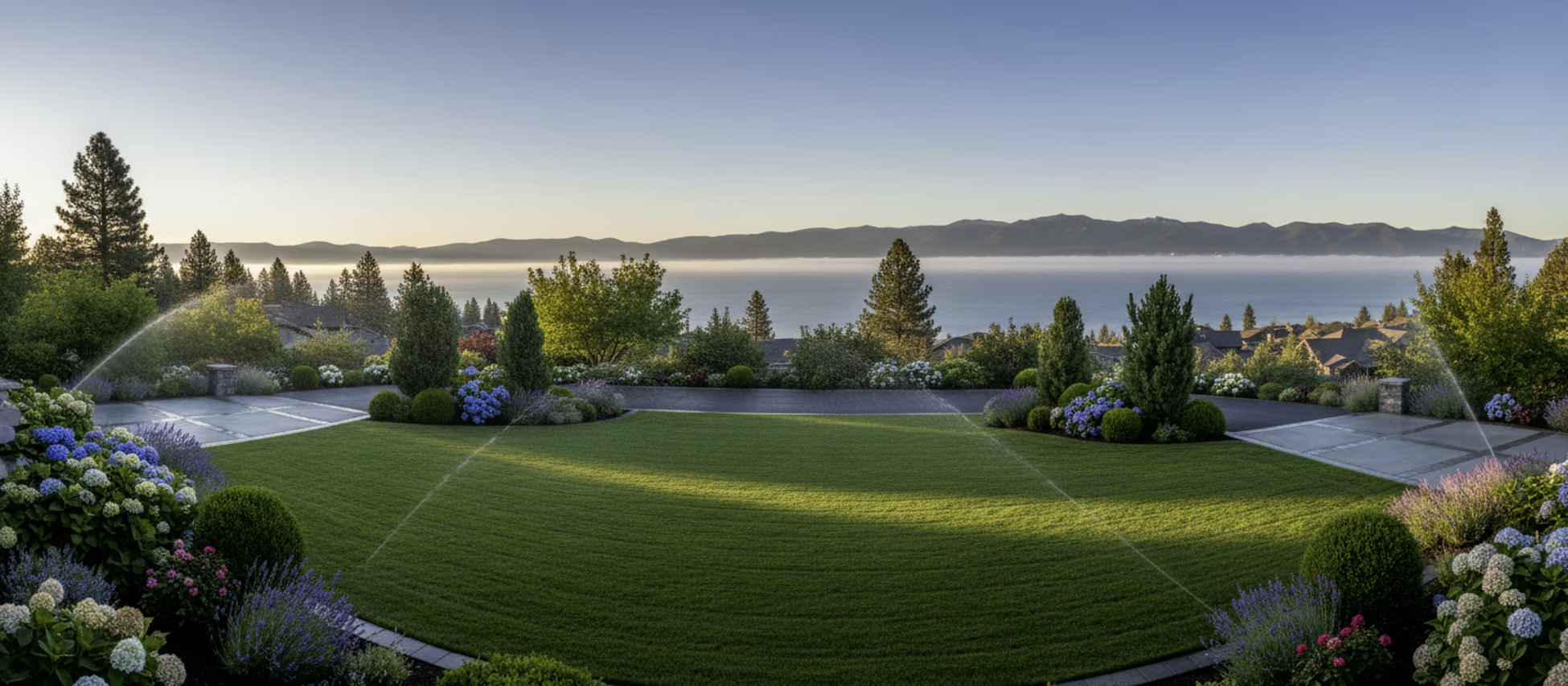

Welcome to Lake Scaping LLC, your premier destination for exceptional luxury landscaping services tailored specifically for the unique beauty of Incline Village and Crystal Bay, Nevada. Our specialized approach combines artistic design sensibilities with practical expertise in high-elevation yard maintenance, ensuring your property not only looks stunning but thrives in the challenging alpine climate.
As a local, family-owned business operating in the breathtaking landscapes of Incline Village and Crystal Bay, we understand that traditional landscaping approaches simply don't translate effectively at our elevation. At 6,200 feet, with a dramatically shortened growing season of just 90-120 days (typically from late May to mid-September), our team has developed specialized techniques that respect the environment while maximizing your property's potential.
Unlike lower elevation areas which enjoy significantly longer growing periods, our services must be strategically timed and executed with precision. This requires a deep understanding of alpine plant hardiness, efficient water management systems designed for mountain conditions, and careful planning that ensures maximum beauty during the limited growing window.
At Lake Scaping LLC, we offer comprehensive landscaping solutions designed specifically for properties in Incline Village and Crystal Bay, NV. Our services go beyond basic yard maintenance to deliver sophisticated, custom designs that enhance your home's value and create outdoor living spaces you can truly be proud of.
Our premium landscaping offerings include:
Managing a property at elevation requires specialized knowledge of seasonal cycles. Our comprehensive yard maintenance services are specifically calibrated to the unique requirements of Incline Village and Crystal Bay properties:
Spring: We begin with a complete assessment, focusing on snow removal, clearing walkways, and preparing the landscape for the growing season. Early spring is also the perfect time for planting new shrubs and trees that thrive in our climate.
Summer: Our team implements strategic irrigation, performs regular mowing and trimming, and addresses any pest or disease issues that may arise. We also conduct seasonal inspections of irrigation systems and outdoor structures.
Fall: As temperatures begin to drop, our services focus on preparing plants for dormancy, installing protective coverings if needed, and planning for the upcoming winter. Cleanup and preparation of garden beds are essential tasks during this season.
Winter: We maintain access to key pathways and provide essential snow removal services. Our team also performs critical winter pruning to ensure healthy plant growth for the next growing season.
Our landscape design services for Crystal Bay and Incline Village properties prioritize both beauty and functionality. When designing for high elevation, we focus on:
The compressed growing season at Incline Village—roughly Memorial Day through Labor Day for most warm-season tasks—demands a yard care schedule that prioritizes timing. A task performed 2 weeks late at Tahoe elevation can mean missing the window entirely for that season. Fertilizer applied after mid-August stimulates growth that won't harden before frost; pruning done during bark beetle season puts pines at risk; irrigation startup before soil temperature supports growth wastes water on dormant plant material.
Lakescaping LLC's Incline Village yard care programs are built around the actual phenology (seasonal timing) of plant material and the environmental conditions of Lake Tahoe, not generic maintenance schedules adapted from lower-elevation markets. This timing precision is what separates effective alpine yard care from well-intentioned but misdirected effort.
Irrigation startup: Begin with visual inspection for winter damage before pressurizing the system. Zone-by-zone activation with head adjustment and damage repair. Smart controller (Rainbird or Toro) programming for spring watering schedule.
Damage assessment: Walk all hardscape for frost heave, assess planting areas for erosion and winter damage, identify plants that need pruning back to live tissue. Schedule repair work before the growing season accelerates.
Pre-emergent weed control: Apply pre-emergent herbicide before soil temperatures reach 55°F to prevent germination of annual weeds in disturbed soil. This is the highest-ROI single weed management intervention of the year.
Fertilization (where appropriate): Apply slow-release fertilizer to turf areas and non-native ornamental plantings that benefit from supplemental nutrition. Native plants do not require fertilization in most Tahoe Basin soils. Apply before mid-June to allow full utilization during the primary growing season.
Mulch replenishment: Top-dress planting beds with 2–3 inches of arborist wood chips where winter erosion or decomposition has reduced mulch depth. Mulch after pre-emergent application to lock in the application.
Mowing: Natural grass lawns at Incline Village should be maintained at 3–4 inch height during summer—taller than lower-elevation recommendations because taller grass shades roots and retains soil moisture during the high-UV, low-humidity summer months. Mow with sharp blades to prevent tearing.
Targeted weed management: Post-emergent herbicide applications for invasive species (cheatgrass, whitetop, mullein) while plants are actively growing. Hand removal of weeds in areas near sensitive plantings or waterways where herbicide use is restricted.
Tree and shrub monitoring: Inspect pines for bark beetle entry holes (boring dust, pitch tubes, yellowing crowns). Early detection allows treatment before tree loss. Monitor for other pest and disease issues during peak growing season.
Irrigation winterization: Critical window: complete before first hard freeze (typically late September to mid-October at Incline Village). Full compressed-air blow-out of all zones. Smart controller set to rain/off mode. Backflow preventer insulated or removed.
Plant protection: Install A-frame snow shields over susceptible ornamental shrubs. Apply anti-desiccant spray to broadleaf evergreens and susceptible conifers. Stake sensitive plants and secure elements that could be damaged by snow loading.
Fall fertilization (turf): A late-season fertilizer application for turf promotes root development before dormancy and provides nutrients for spring green-up. Apply potassium-based (not nitrogen-heavy) formulation to avoid frost-tender growth flush before dormancy.
Natural grass lawns at Incline Village face significant challenges: the growing season is only 90–120 days, UV intensity is high, and temperature swings between day and night are extreme. The grass varieties that work best are cool-season grasses suited to the cold nights:
Tall fescue: The most reliable natural grass for Incline Village conditions. Deep root system provides better drought tolerance than other cool-season species. Tolerates the temperature extremes and drier mid-summer conditions better than bluegrass. Mow at 3–4 inches.
Kentucky bluegrass: Popular in Tahoe Basin landscapes, but requires more supplemental water than tall fescue and suffers more in summer heat stress. Best reserved for high-use or high-visibility areas where its dense, uniform texture justifies the additional water use.
Perennial ryegrass: Used for overseeding damaged areas and for quick establishment on disturbed soils. Less cold-tolerant than fescue and bluegrass; may thin out in severe winters. Not recommended as a primary lawn species at Incline Village elevations.
Lakescaping LLC (Nevada C-10 #0086320) has served property owners in Incline Village, Crystal Bay, Glenbrook, and Zephyr Cove for 33+ years. Contact us for a no-obligation on-site consultation to assess your property's specific needs.
Serving Nevada properties only — Incline Village, Crystal Bay, Glenbrook, and Zephyr Cove.
Tall fescue is our primary recommendation for natural grass lawns at Incline Village. Its deep root system provides better drought tolerance than bluegrass or ryegrass, and its heat stress resistance is superior for the high-UV Tahoe summer. A blend of tall fescue varieties (endophyte-enhanced) provides insurance against disease or pest pressures affecting a single variety. Kentucky bluegrass can be used for high-visibility areas where its denser texture justifies the additional water use.
Two fertilizer applications per season are appropriate for most Incline Village lawns: an early-season application in late May or early June using a balanced slow-release formulation, and a late-season application in September using a potassium-focused formulation that promotes root development without stimulating frost-tender shoot growth. Avoid nitrogen-heavy fertilizers after mid-August. Native plants and drought-adapted shrubs generally do not need fertilization in Tahoe Basin soils.
Cheatgrass control requires correctly timed herbicide application when the grass is in the seedling stage but before native species are actively growing — typically late April to early May at Incline Village. Pre-emergent applications before germination are also effective. Dense native groundcovers and turf that close the canopy to prevent bare soil exposure are the most sustainable long-term control strategy. Cheatgrass is an annual that requires bare or disturbed soil to establish; preventing bare soil is the most effective prevention measure.
Mow at 3–4 inches height at Incline Village. The higher mowing height compared to standard residential lawns (typically 2–3 inches) is appropriate because taller grass shades the soil surface at the high UV intensity of 6,200 feet elevation, retains soil moisture during summer dry periods, and develops a deeper root system with higher drought tolerance. Never remove more than one-third of the blade height in a single mowing — cutting more than that stresses the grass and sets back summer establishment.
Tall fescue lawns at Incline Village typically need 1.0–1.5 inches of water per week during peak summer (late June through August). Natural precipitation provides a fraction of this in most years. With a smart Rainbird or Toro controller and ET-based scheduling, the system will apply water based on actual evapotranspiration demand rather than a fixed schedule — typically cycling irrigation 2–3 times per week. Avoid daily light watering, which promotes shallow root systems and increases disease susceptibility.
our mountain estate deserves expert craftsmanship. Partner with our licensed Nevada team to design and build a resilient, high-end landscape tailored to your vision.