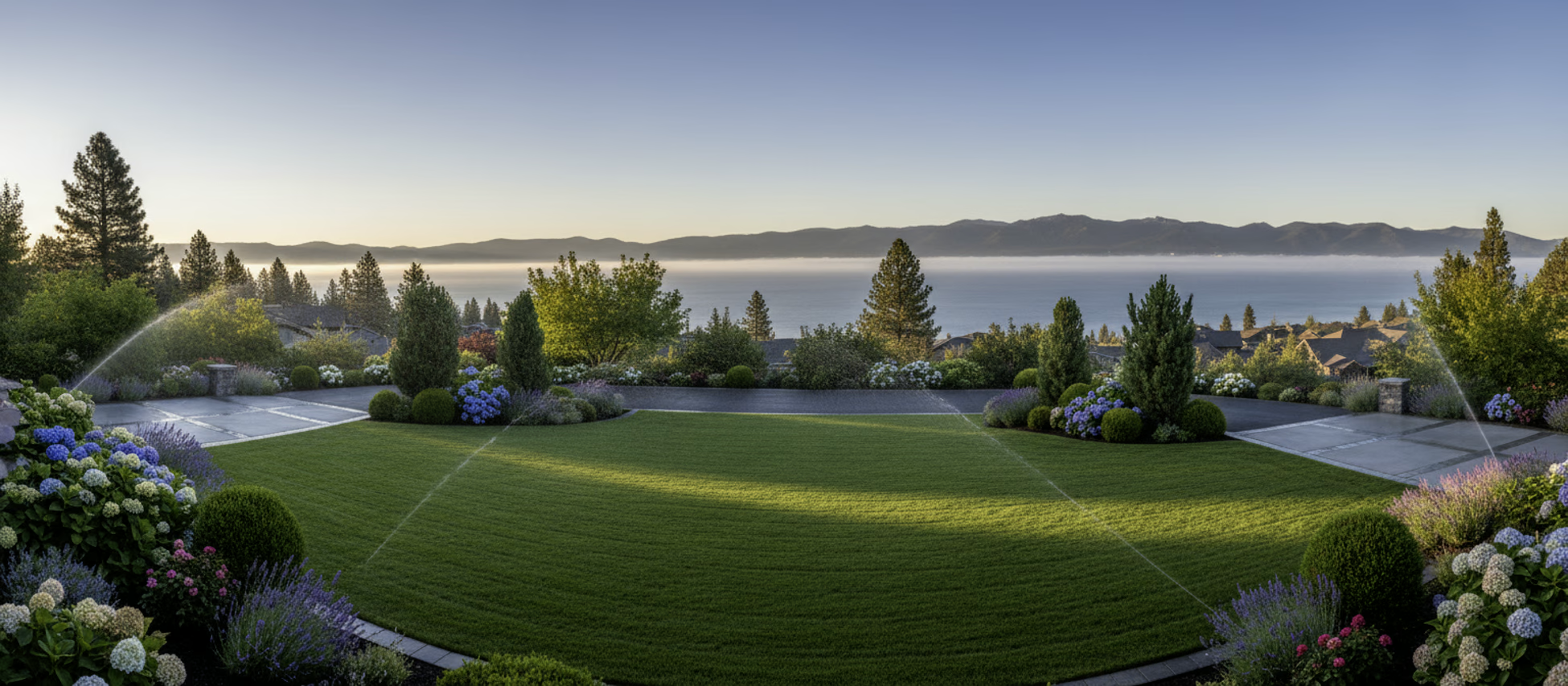

Irrigation efficiency at Lake Tahoe is both an environmental requirement and a practical cost management strategy. TRPA's Best Management Practice standards require that irrigation systems apply water without creating runoff that enters the lake's drainage system. Smart controller technology and proper system design are the technical tools that achieve this standard while reducing water costs for property owners.
Lakescaping LLC designs, installs, and audits irrigation systems for residential and estate properties throughout Incline Village, Crystal Bay, Glenbrook, and Zephyr Cove. We specify Rainbird and Toro smart controller systems and design irrigation zones around actual plant water needs at Lake Tahoe's 6,200-foot elevation.
TRPA's Best Management Practice standards for residential landscaping in the Lake Tahoe Basin include specific requirements for irrigation system design and operation. The core requirement is straightforward: irrigation water should be applied to plants at rates and frequencies appropriate to their actual water needs, without overapplication that creates runoff entering the lake. In practice, this means smart controllers, properly designed head coverage to avoid pavement overspray, and regular system auditing to confirm the system is operating as designed.
Lakescaping LLC designs, installs, and audits irrigation systems for residential and estate properties throughout Incline Village, Crystal Bay, Glenbrook, and Zephyr Cove. Our systems are designed around actual plant water needs at Lake Tahoe elevations—not generic watering schedules that were developed for lower-elevation or warmer climates.
The single highest-impact improvement available for most existing irrigation systems at Incline Village is replacement of a conventional timer controller with a smart (ET-based) controller. Smart controllers calculate evapotranspiration—actual plant water demand—from local weather data and adjust irrigation schedules automatically. The result is irrigation that tracks actual plant needs rather than running on a fixed schedule regardless of recent rainfall, temperature, or humidity.
Rainbird's professional-grade smart controller series is our primary specification for residential irrigation at Incline Village. The ESP-TM2 with the LNK WiFi module provides local weather-based ET adjustment, smartphone-accessible scheduling and monitoring, and a controller architecture that supports up to 22 zones for large estate properties. Rainbird's customer service and technical support infrastructure is the strongest in the industry—important for remote vacation property owners who need to resolve issues without being on-site.
Toro's Evolution smart controllers are our alternative specification for properties with existing Toro system infrastructure. The Evolution series uses the same ET-based logic as Rainbird and provides comparable functionality. We specify the controller brand that best integrates with existing system components to minimize material costs and maximize compatibility.
Spray and rotor irrigation for planting areas—as opposed to turf areas—is almost always inefficient. Spray heads apply water over a broad area, much of which falls on mulch or bare soil between plants rather than in the root zones of target plants. Drip irrigation systems deliver water directly to root zones at rates that allow soil absorption without runoff. For Tahoe Basin planting beds, our drip irrigation design standards:
Emitter placement: One emitter per small-to-medium shrub, two for larger shrubs. Emitters positioned 6 inches from the trunk to keep the trunk base dry (reducing rot risk) and deliver water to the active root zone.
Emitter type: Pressure-compensating emitters (Rainbird PCND or Toro equivalent) are specified for all planting bed applications. Pressure-compensating emitters deliver consistent output regardless of supply pressure variation—critical on sloped sites where gravity creates pressure differentials across the system.
Zone design: Drip zones group plants with similar water needs: establishment-phase natives with moderate drip requirements on one zone, non-native ornamentals with higher needs on another. This allows appropriate scheduling for each group without overwatering the more drought-tolerant species.
An irrigation system that was well-designed but has not been audited since installation is typically operating with multiple inefficiencies: blocked or tilted heads, broken emitters, zone overlaps that have developed as head positions shifted, and controller schedules that were set for establishment and never adjusted. Our irrigation audit process:
Zone-by-zone evaluation: We run each zone and document head coverage, precipitation rate, and head condition. We identify blocked heads, heads spraying pavement, and coverage gaps.
Water budget calculation: Using local ET data for Incline Village, we calculate appropriate water application rates for each zone's plant material and compare to current scheduling. Most systems we audit are running 30–50% more water than plants require.
System repair and reprogramming: We correct identified deficiencies—replacing blocked heads, adjusting aim and arc, adding heads where coverage gaps exist—and reprogram the controller with ET-based schedules appropriate to the plant material and current season.
Lakescaping LLC (Nevada C-10 #0086320) has served property owners in Incline Village, Crystal Bay, Glenbrook, and Zephyr Cove for 33+ years. Contact us for a no-obligation on-site consultation to assess your property's specific needs.
Serving Nevada properties only — Incline Village, Crystal Bay, Glenbrook, and Zephyr Cove.
Smart controllers typically reduce irrigation water use by 20–40% compared to conventional timers running fixed schedules, based on studies by water agencies and irrigation industry associations. The savings are highest when conventional timers have been programmed with conservative (frequent, short) watering schedules that don't account for rainfall or temperature variation. At Incline Village, where cool temperatures and regular summer afternoon thunderstorms frequently reduce plant water demand below what fixed schedules apply, smart controllers provide significant savings.
Evapotranspiration (ET) is the combined rate of water loss from soil evaporation and plant transpiration. ET-based irrigation controllers use local weather data — temperature, humidity, wind speed, and solar radiation — to calculate daily ET and apply irrigation water to replace what plants actually used. On cool, humid days with no sun, ET is low and the controller applies little or no water. On hot, dry, windy days, ET is high and the controller applies more. The result is irrigation that closely tracks actual plant water demand.
Irrigation system upgrades that improve efficiency and reduce water application — installing smart controllers, converting spray to drip, repairing leaks — do not typically require TRPA permits. Significant expansion of the irrigated area (adding zones, extending coverage to new areas) may require a BMP review if the expansion increases water delivery to sensitive areas. We can advise on permit requirements for your specific project before work begins.
Common signs of overwatering include moss or algae growth on soil or hardscape surfaces, persistently wet soil between irrigation cycles, mushroom emergence in lawn or planting areas, yellowing leaves on plants that appear otherwise healthy (a counter-intuitive sign of root rot from waterlogging), and visible water runoff during or after irrigation cycles. Many Incline Village properties were set up with watering schedules appropriate for establishment-phase plantings and never reduced after plants matured.
We recommend a full irrigation audit every 2–3 years for systems in active use, plus a spring startup inspection each year. The spring inspection catches winter damage and verifies system operation before the irrigation season begins. A full audit evaluates head coverage, precipitation rates, and scheduling against current plant water needs — which change as plants mature and as native plants achieve establishment and no longer need supplemental irrigation.
our mountain estate deserves expert craftsmanship. Partner with our licensed Nevada team to design and build a resilient, high-end landscape tailored to your vision.