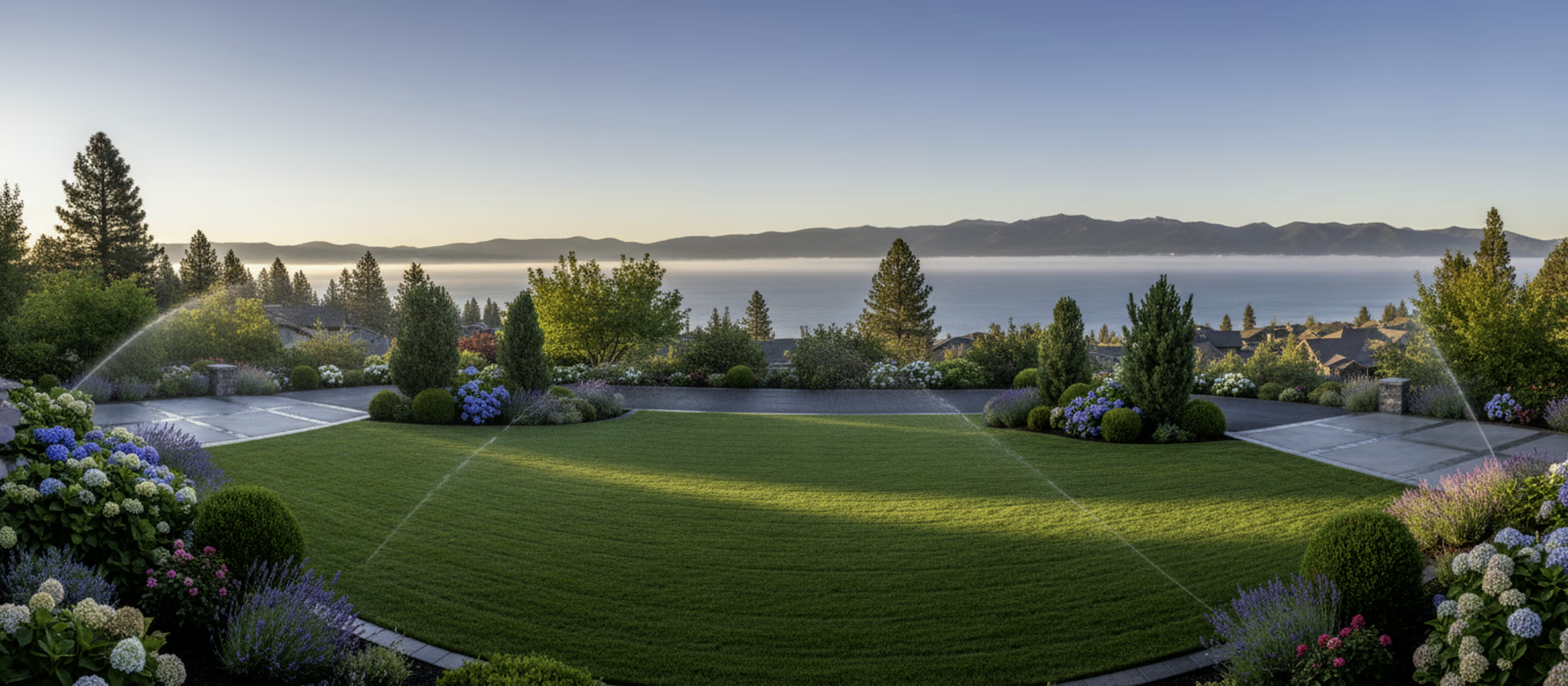

Property owners in Incline Village and Crystal Bay face a turf decision that doesn't exist at lower elevations: natural grass must survive a growing season compressed to roughly 120 days (June through September), endure -10°F winters under 8 feet of snow, and perform on soils that are predominantly decomposed granite with limited water-holding capacity. These constraints push many homeowners toward synthetic alternatives—but not all synthetic products perform equally at altitude, and natural turf remains the right choice for many applications.
This guide compares both options across the factors that matter most to Nevada Lake Tahoe property owners: water consumption, maintenance demands, durability, aesthetics, TRPA compliance, and total cost of ownership.
Warm-season grasses (Bermuda, zoysia, St. Augustine) are not viable at Incline Village—they cannot survive the winter dormancy period and will not recover in spring. Cool-season grasses are the only option, and not all cool-season species perform well at altitude. Our specifications for Lake Tahoe natural turf areas:
Natural turf in Incline Village requires approximately 1.5–2.0 inches of water per week during summer peak (July–August), accounting for elevated evapotranspiration rates at altitude. For a 1,000 square foot lawn, this equates to 900–1,200 gallons per week—a significant water draw that TRPA is increasingly scrutinizing in the context of Lake Tahoe basin water conservation.
Natural turf requires weekly mowing during the growing season (12–18 weeks), fertilization 3–4 times per year, aeration and dethatching annually, and overseeding thin areas each fall. Total annual maintenance labor for a 1,000 sf lawn: approximately 30–40 hours.
Not all synthetic turf performs equally at Lake Tahoe. Temperature extremes, UV exposure, and heavy snow loads create performance requirements that separate quality products from budget options. We specify products meeting these minimum standards:
The base system under synthetic turf is where most failures occur at altitude. A properly engineered base for Incline Village includes:
Under-engineered bases heave, shift, and develop drainage problems within 2–3 seasons at Lake Tahoe's freeze-thaw intensity.
Synthetic turf handles snow load well compared to natural grass, which can suffer crown damage under heavy snowpack. Snow can be removed from synthetic turf with a plastic snow shovel without damage—never use metal-edged tools. Synthetic turf that is properly installed will recover its pile orientation after snowmelt without additional intervention.
Water: Natural turf 900–1,200 gal/wk for 1,000 sf; synthetic 0 irrigation water (cleaning only)
Annual maintenance cost: Natural $800–1,500 (mowing, fertilizing, aeration); synthetic $200–400 (periodic brushing, cleaning, minor infill top-up)
Installation cost: Natural $2–4/sf; synthetic $12–18/sf installed
Lifespan: Natural indefinite with maintenance; synthetic 15–25 years before replacement
TRPA compliance: Natural requires irrigation management plan; synthetic eliminates irrigation runoff concern
Best for: Natural—show lawns, areas with children/pets who prefer natural feel; synthetic—low-maintenance areas, pet runs, play areas, steep slopes, areas with overhead tree cover
Lakescaping LLC (Nevada C-10 #0086320) has served property owners in Incline Village, Crystal Bay, Glenbrook, and Zephyr Cove for 33+ years. Contact us for a no-obligation on-site consultation.
Serving Nevada properties only — Incline Village, Crystal Bay, Glenbrook, and Zephyr Cove.
Synthetic turf surface temperatures can reach 140–160°F in full summer sun, even at altitude. This is significantly hotter than natural grass (80–90°F). We address this with light-colored infill products that reduce heat absorption, and recommend strategic placement in areas with afternoon shade or low foot traffic during midday. The issue is less pronounced at Lake Tahoe than at lower elevations due to cooler average temperatures.
Yes. Synthetic turf is considered an impervious surface alternative under TRPA regulations, but it has a special classification due to its permeability. The classification can affect land coverage calculations. We calculate TRPA land coverage compliance for every synthetic turf installation and can advise on whether your project requires a TRPA permit or review.
Quality synthetic turf handles snow load well. The fibers are UV-stabilized and designed to recover after compression. After snowmelt, light brushing with a soft-bristle broom restores pile orientation. We avoid installing synthetic turf on surfaces where snowplowing with metal blades is planned—snow should be removed with plastic shovels or by hand in synthetic turf areas.
A properly designed base with adequate drainage handles rainfall at the rate of 30+ inches per hour—far above what Lake Tahoe experiences even during peak spring storms. Infill material is mechanically locked in place by the turf fibers and does not wash out in normal rain events. Perimeter edging prevents infill migration to adjacent areas.
Yes. Putting green synthetic turf (shorter pile, denser construction) is one of our most popular specialty applications. We design and install custom putting greens with undulation, fringe areas, and cup installations. Putting greens have different base and drainage specifications than standard synthetic turf and require a specialized installation approach.
our mountain estate deserves expert craftsmanship. Partner with our licensed Nevada team to design and build a resilient, high-end landscape tailored to your vision.