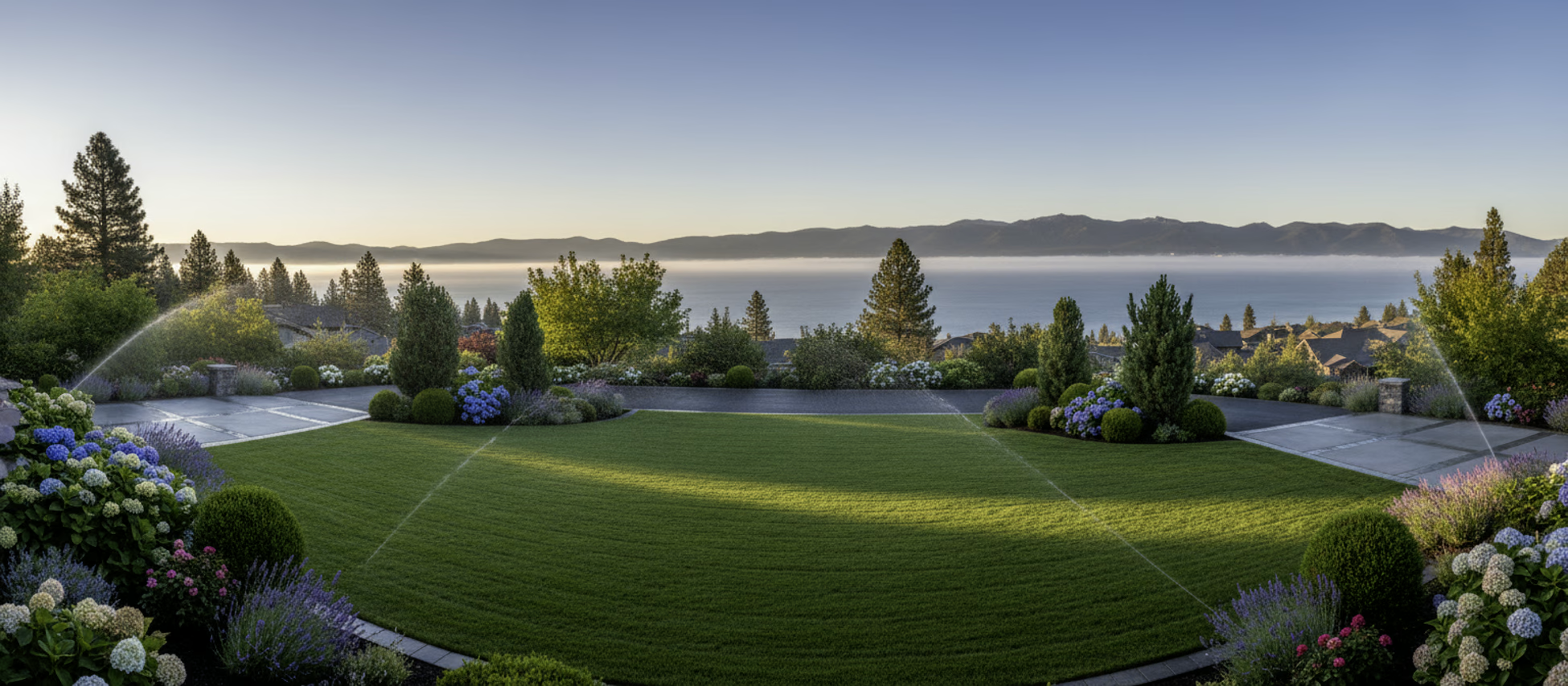

Synthetic grass in Incline Village, Nevada addresses the growing conflict between the desire for lush turf areas and Nevada's water resource realities. At 6,200 feet above sea level, natural turf requires significant irrigation during the 90-day growing season — often 1–1.5 inches per week during peak July heat — in a state where water rights are increasingly regulated and water costs continue to rise. The compressed season means that all the irrigation burden is concentrated in a 3–4 month window when IVGID water rates are highest and when outdoor water use restrictions are most likely to be imposed during drought years.
Synthetic grass installations by Lakescaping LLC at Incline Village and Crystal Bay replace water-consuming turf areas with a surface that requires no irrigation, no fertilization, no mowing, and minimal maintenance while maintaining year-round visual quality. For property owners who want the aesthetic benefit of green ground cover without the water cost and maintenance burden, synthetic grass provides a compelling solution in the Tahoe basin context.
Nevada is the driest state in the contiguous United States, and the Tahoe Basin's water supply feeds the Lake Tahoe watershed whose health is the focus of TRPA's entire regulatory mission. IVGID (Incline Village General Improvement District) water rates have increased significantly over the past decade, and tiered water pricing means that landscape irrigation for natural turf becomes progressively more expensive as seasonal usage rises. Converting natural turf areas to synthetic grass directly reduces water consumption for the property — a typical 1,000 square foot natural grass area at Incline Village uses 15,000–25,000 gallons per irrigation season; synthetic grass reduces this to near-zero landscape irrigation water use.
Water rebate programs through IVGID and Nevada DWR have historically offered rebates for turf conversion projects. Lakescaping LLC maintains current information on active rebate programs for Incline Village and Crystal Bay property owners — these programs change over time, and we advise clients on available incentives at the time of project planning. The combination of reduced water costs and rebate incentives can substantially improve the economics of synthetic grass installation.
The drainage engineering of a synthetic grass installation at Incline Village is the most critical determinant of long-term performance. At 6,200-foot elevation, the drainage system must handle three distinct scenarios that do not all apply at lower-elevation installations:
Summer thunderstorm events: Short-duration, high-intensity summer thunderstorms at Incline Village can deliver 0.5–1.0 inch of rain in 30 minutes. The aggregate base and lateral drainage system must accept this flow without saturation. Our standard aggregate base (8–10 inches of Class II 3/4-inch crushed stone) combined with perforated pipe drainage to daylight provides drainage capacity exceeding this peak event flow rate.
Spring snowmelt: Snowmelt at Incline Village is a sustained high-volume drainage event that can last 2–6 weeks in April–May. Unlike a thunderstorm, snowmelt continuously recharges the aggregate base with meltwater throughout the day during warm spring weather. Base saturation that causes frost heaving is the risk here — the drainage system must keep the aggregate base drained to prevent ice lens formation during the freeze periods within the snowmelt season.
Freeze-thaw base stability: The 180 days of below-freezing nights at Incline Village mean that the aggregate base freezes repeatedly. Aggregate with fine material content (silt and clay) retains water that expands when frozen, causing frost heaving and surface undulation over time. We use clean washed aggregate with less than 3% fines content to eliminate this mechanism. The extra material cost of clean aggregate is negligible compared to the cost of rebuilding a failed base 5–8 years after installation.
The synthetic grass product used for an Incline Village installation must be rated for alpine UV conditions and freeze-thaw exposure. Key product specification considerations:
UV stabilization: At 6,200 feet, UV intensity is 25–30% higher than sea level. Products manufactured with non-UV-stabilized polyethylene fibers will bleach and become brittle within 3–5 years at this elevation. We specify UV-stabilized polyethylene fiber products with manufacturer warranty language that explicitly covers high-altitude installation — some manufacturer warranties exclude installations above 5,000 feet elevation, which would include all of Incline Village.
Fiber pile height: 1.5–2.0 inch pile height is appropriate for most Incline Village applications. Shorter pile (under 1 inch) provides less cushioning and a less natural appearance; longer pile (over 2 inches) requires more maintenance to keep upright and accumulates more pine needle debris. For putting green applications, pile height of 3/8–1/2 inch provides appropriate ball roll characteristics.
Backing permeability: All Incline Village synthetic grass installations should use products with perforated or permeable backing rather than solid backing. This allows immediate liquid infiltration into the aggregate base rather than ponding on the surface — critical for both pet areas and the high precipitation events of alpine climate.
The most successful synthetic grass installations at Incline Village integrate the turf area with surrounding native planting, natural stone, and hardscape elements that reflect the alpine character of the site. Synthetic grass installed as a discrete rectangular panel with no surrounding landscape context reads as an obvious substitute rather than an intentional design decision.
Effective integration approaches used by Lakescaping LLC at Incline Village: irregular or organic turf perimeter shapes that follow natural topography rather than rectangular lots, surrounding Belgard or natural stone border edging that visually anchors the turf panel, native shrub planting adjacent to turf areas that provides seasonal color and visual complexity, and decomposed granite or crushed gravel transitions that maintain the alpine material palette. The goal is a landscape that reads as carefully designed rather than as a grass substitute — and that satisfies HOA requirements for natural character in common view areas.
For properties with TRPA land coverage constraints, permeable synthetic grass systems using perforated backing and clean open aggregate base may qualify for reduced impervious surface calculation compared to solid impervious paving. Lakescaping LLC evaluates land coverage implications and permeable system options for all Incline Village synthetic grass projects.
Lakescaping LLC (Nevada C-10 #0086320) has served property owners in Incline Village, Crystal Bay, Glenbrook, and Zephyr Cove for 33+ years. Contact us for a no-obligation on-site consultation to assess your property's specific needs.
Serving Nevada properties only — Incline Village, Crystal Bay, Glenbrook, and Zephyr Cove.
Synthetic grass with permeable backing and clean aggregate base may qualify as permeable surface for TRPA land coverage purposes in certain land capability classifications, which can allow synthetic grass installation where solid impervious paving would exceed coverage limits. However, this determination is site-specific and depends on the property's Bailey Land Capability Classification and existing coverage usage. Lakescaping LLC evaluates TRPA land coverage implications before all synthetic grass projects and designs systems to optimize coverage compliance where constraints exist.
For general landscape and lawn replacement applications at Incline Village, silica sand infill provides adequate performance with minimal environmental concern. For pet areas, zeolite-blended infill provides partial ammonia absorption for odor management. For putting greens, fine silica sand at lower infill rates (1–2 lbs per square foot) provides appropriate ball roll. Crumb rubber infill is acceptable for high-traffic sports areas but is not our default recommendation for Incline Village residential installations where organic composition is preferred. We avoid infill products with PFAS or other persistent chemical concerns in the Tahoe basin's sensitive water quality context.
Synthetic grass can be installed on slopes up to approximately 20–25% grade with proper base preparation and drainage engineering. Steeper slopes require retaining elements (borders, edging, or integral turf anchoring) to prevent the turf from migrating downslope as infill settles. On slopes, cycle-and-soak drainage design prevents saturation — the aggregate base on a slope must drain laterally as well as downward. Lakescaping LLC has installed synthetic grass on Incline Village's characteristically steep residential lots and designs base drainage specifically for sloped installations.
In markets where water conservation is valued and natural turf maintenance is recognized as a significant cost, synthetic grass in appropriate applications (pet areas, play areas, drought-conversion areas) is generally viewed as a value-neutral to value-positive feature by buyers familiar with the Incline Village market. Whole-property synthetic turf replacement may be viewed negatively by buyers who prefer the aesthetic of natural turf. The most positive value impact comes from selective synthetic turf use in functional areas (pet runs, play courts, rear yard turf areas) combined with native planting and quality hardscape in primary view areas — a design approach that demonstrates both water consciousness and premium landscape quality.
The optimal window for synthetic grass installation at Incline Village is late May through September, after the snow season ends and before freeze-up in October–November. June and July are ideal: the base can be compacted in warm, dry conditions without interference from snowmelt or early fall rains, and the turf can settle and establish its edge trim before winter. Installation in August and September is feasible but provides less time before first frost. Winter installation is not recommended — frozen ground prevents proper base compaction, and working in snow conditions produces poor base density. Lakescaping LLC schedules synthetic grass installations for our Incline Village clients in the late spring to early fall window.
our mountain estate deserves expert craftsmanship. Partner with our licensed Nevada team to design and build a resilient, high-end landscape tailored to your vision.