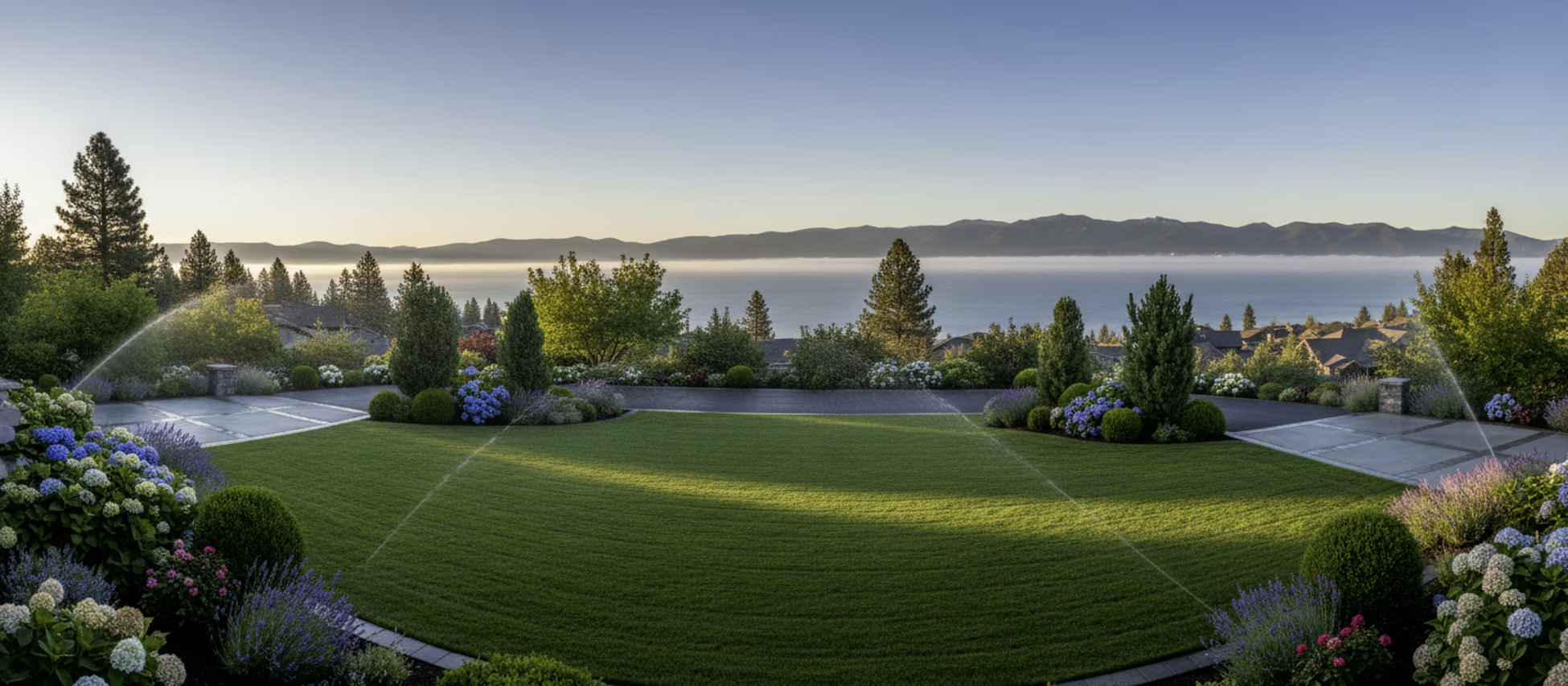

Spring snowmelt at Lake Tahoe represents the most challenging transition period in the annual landscape cycle. Compressed snowpack releases months of precipitation in weeks, testing drainage systems, hardscape integrity, and plant protection measures installed in fall. Lakescaping LLC provides comprehensive spring recovery services for Incline Village, Crystal Bay, Glenbrook, and Zephyr Cove properties — identifying and addressing post-winter damage before the growing season begins.
The weeks following the primary snowmelt at Incline Village—typically late April through June depending on the season's snowpack—are a critical window for landscape assessment and recovery. Heavy snowpack years can cause damage that remains invisible under snow for months: erosion channels that formed under the snowpack, ice dams that redirected meltwater into unintended areas, branches broken under snow loading, and frost heaving that displaced pavers and landscape edging.
Lakescaping LLC's spring recovery program is designed to systematically assess and address post-winter damage before the growing season begins. Early intervention—before weeds establish in eroded areas, before heaved pavers cause trip hazards, before damaged irrigation heads waste water at startup—is far more cost-effective than reactive repairs later in the season.
Paver surfaces: Freeze-thaw cycling can cause localized heaving where base material was compromised or where drainage was inadequate to prevent ice formation in the base. We walk all paved surfaces and probe for loose, heaved, or settled pavers. Individual paver repair is straightforward if addressed before the area experiences further loading or before joint sand is displaced by rain.
Retaining walls: Post-winter is the optimal time to assess retaining wall performance after a full freeze-thaw cycle. Signs of concern include forward lean, horizontal cracking in the wall face, or soil staining on the wall face indicating water intrusion. Walls that are developing failure patterns need engineering assessment before the next winter accelerates the failure.
Steps and edge treatments: Step treads can shift individually under freeze-thaw loading. We check rise and tread consistency at all step locations and reset individual treads that have shifted. Bender board and aluminum edging along paved areas is checked for frost heave displacement.
Spring irrigation startup at Incline Village must be preceded by a complete system inspection before the system is pressurized. This is not a formality—a single cracked pipe or stuck valve body can flood a planting area or structure basement before the problem is identified if the system is activated without inspection. Our startup protocol:
Visual inspection before startup: Walk all known pipe routes and head locations looking for obvious freeze damage—cracked risers, displaced heads, damaged valve boxes—before water is introduced to the system.
Zone-by-zone activation: Activate each zone individually and walk the zone while it operates, confirming that all heads function correctly, no pipe is leaking at a joint, and head coverage is appropriate for the plant material. Adjust tilted heads and replace damaged heads before moving to the next zone.
Controller programming review: Confirm that the smart controller (Rainbird or Toro) is programmed for the current season's watering needs. Many properties have winter rain/off settings that need to be updated for the irrigation season.
Erosion evaluation: Identify areas where snowmelt flow caused soil displacement. Concentrated flow channels in mulched beds indicate that surface drainage routing changed over the winter—often due to snow removal pushing snow accumulations to new locations that redirected melt flow. Regrading and mulch replenishment address these issues before weed establishment.
Plant damage: Assess all landscape plantings for winter damage. Dead or brown foliage on broadleaf evergreens may indicate winter desiccation; prune damaged material back to live tissue. Broken branches on pines should be removed at the branch collar. Snow mold—a gray fungal growth on turf—clears naturally with air circulation but can be treated if persistent.
New weed establishment: The disturbed soil in eroded areas is prime real estate for invasive weed establishment. Spring is the most critical time for pre-emergent weed control, applied before weed seeds germinate in warmed soil.
A landscape designed for year-round performance at Lake Tahoe must manage concentrated snowmelt flow as effectively as it manages summer rain. The annual snowmelt at Incline Village represents the equivalent of 200+ inches of precipitation concentrated into a few weeks—far more than typical summer storms and capable of causing erosion damage that annual rain events never approach.
Channel maintenance: Drainage swales and channels should be cleared of debris accumulated over winter before the primary snowmelt begins. Blocked channels redirect flow to unintended areas and concentrate erosive energy.
French drain inspection: French drains installed around foundations and at the base of retaining walls must be checked annually. We inspect outlets for blockage and probe inlet areas for sediment accumulation that could reduce function.
Downspout disconnection assessment: TRPA's BMP standards encourage routing roof downspout discharge to permeable landscape areas rather than to the street or storm drain. We evaluate whether existing downspout discharge locations are functioning as intended or whether melt and rain discharge is creating erosion or heading toward unintended areas.
Lakescaping LLC (Nevada C-10 #0086320) has served property owners in Incline Village, Crystal Bay, Glenbrook, and Zephyr Cove for 33+ years. Contact us for a no-obligation on-site consultation to assess your property's specific needs.
Serving Nevada properties only — Incline Village, Crystal Bay, Glenbrook, and Zephyr Cove.
We begin spring assessments in late April, as soon as lower elevations are clear of snow. Full-property assessments and irrigation startups are typically completed in May. Some high-elevation or north-facing areas may still have residual snowpack into June — we work around remaining snow and complete those areas as they clear. The urgency driver is getting irrigation systems inspected and started before the dry season begins in earnest in June.
Frost heave damage in paved areas appears as localized areas where individual pavers or sections of paving are higher than the surrounding surface. Running your foot across the surface while walking is an effective detection method — heaved areas are immediately apparent. In retaining walls, frost heave may manifest as displacement of individual blocks or as a forward lean that was not present the previous fall. Any displacement that creates a trip hazard should be addressed promptly.
No. Anti-desiccant sprays applied in the fall degrade naturally with UV exposure and weathering over the winter and spring — they do not need to be removed and will not harm the plant as they break down. New growth emerging in spring will not have the coating. By mid-summer, the original treatment will have fully degraded.
Snow mold is a fungal disease that develops under extended snow cover in cool, moist conditions. It appears as circular gray or pink patches of matted, dead-looking turf after snow recedes. Light raking to improve air circulation is the primary treatment for gray snow mold — most turf recovers naturally with warmth and drying. Pink snow mold (Microdochium) is more damaging and may require fungicide treatment. Both are preventable with fall fungicide applications in areas with historically heavy snowpack.
The most effective snowmelt erosion prevention strategies are redirecting concentrated flow from high-volume sources (downspouts, snow dump areas) to level spreaders or infiltration areas before it gains erosive velocity; stabilizing erosion-prone slopes with native groundcover plantings; and installing erosion-control blankets on newly disturbed slopes during the establishment period. We identify erosion patterns from the current year as part of our spring assessment and recommend preventive improvements before the next winter season.
our mountain estate deserves expert craftsmanship. Partner with our licensed Nevada team to design and build a resilient, high-end landscape tailored to your vision.