TRPA land coverage regulations are among the most important site constraints for Incline Village and Crystal Bay property owners. Permeable paving systems—Belgard PICP pavers, stabilized decomposed granite, angular gravel—count at lower coverage values than impervious surfaces under TRPA's classification system, enabling property owners to create usable outdoor space while managing within their coverage budget. Lakescaping LLC designs and installs TRPA-compliant permeable paving systems throughout the Nevada Lake Tahoe communities.
The Tahoe Regional Planning Agency's land coverage limits are among the most consequential development constraints for residential property owners in the Lake Tahoe Basin. TRPA's coverage system classifies all land surfaces into coverage categories—impervious, semi-impervious, and permeable—and limits the total coverage on each parcel based on its land capability district classification.
For many Incline Village and Crystal Bay properties, especially those developed in the 1970s and 1980s when TRPA regulations were less stringent, existing coverage may equal or exceed the current allowable limit. Any new impervious surface—a patio addition, an expanded driveway, a new walkway—may require removing an equivalent area of existing impervious surface to maintain compliance.
Permeable paving systems change this calculus. By replacing impervious surfaces with permeable alternatives, property owners can create usable outdoor space while managing within or even reducing their coverage budget. This makes permeable paving not just an environmental choice but a practical enabling technology for expanding outdoor living areas at coverage-constrained properties.
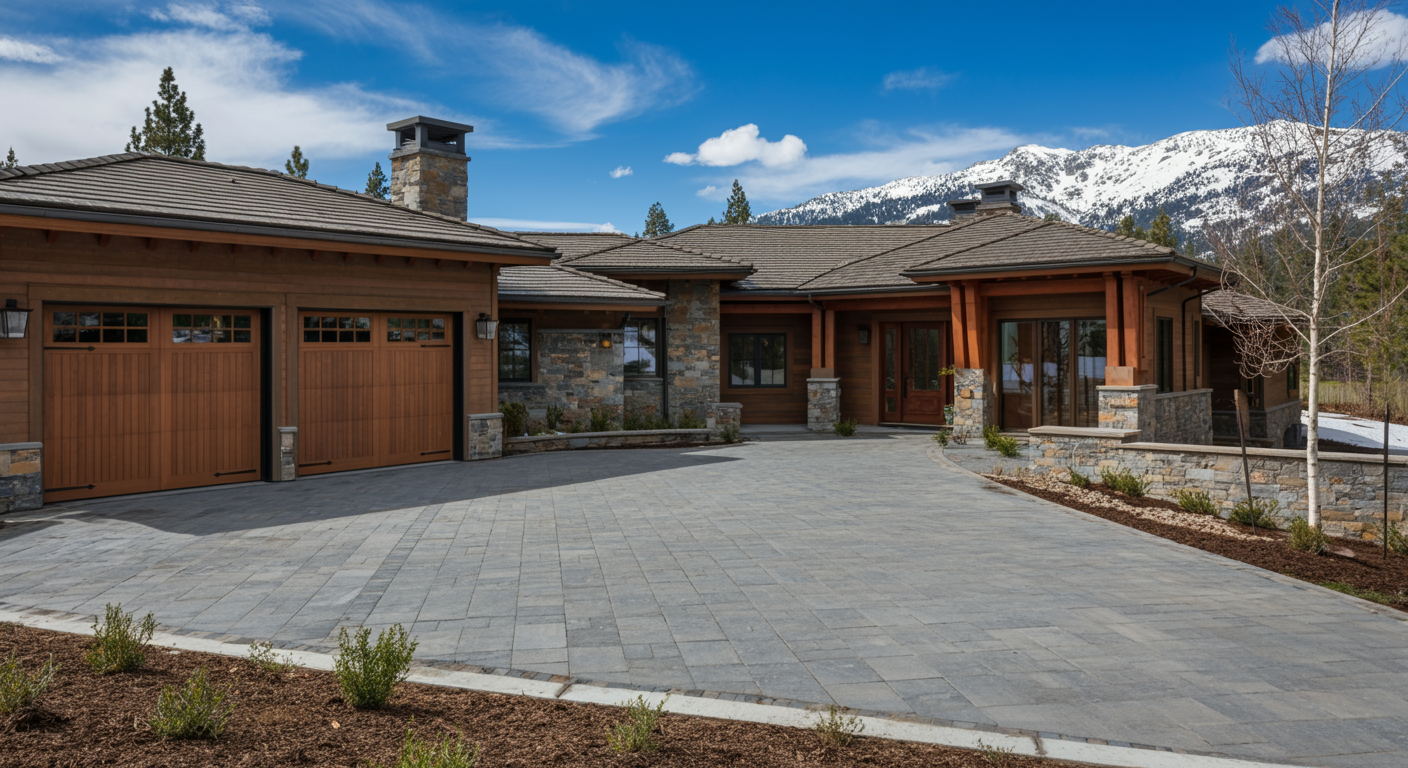
Permeable interlocking concrete pavers are the highest-performance permeable paving system for residential applications at Incline Village. PICP systems use concrete paver units with open joint widths (typically 5–9mm) filled with permeable aggregate. Water infiltrates through the joints into a reservoir aggregate layer below the paver surface, then into the native soil. Properly designed PICP systems can infiltrate rainfall at rates exceeding most storm events.
For Tahoe Basin applications, PICP systems require specific design modifications for freeze-thaw performance:
Open-graded base: The aggregate reservoir below the pavers must be clean, open-graded stone (no fines) with adequate depth to store design storm volumes. Typical depth: 12–18 inches for residential applications, depending on infiltration rate of the underlying soil.
Choker course: A 2-inch layer of clean, smaller aggregate (typically ASTM No. 8 stone) between the reservoir base and the paver bedding course prevents migration of bedding material into the reservoir while maintaining drainage.
Edge restraints: Perimeter restraints must be staked at 12-inch maximum spacing to prevent edge displacement during freeze-thaw cycles that heave the paver surface.
Stabilized decomposed granite (DG) and angular gravel surfaces are fully permeable, low-cost alternatives to paved surfaces appropriate for secondary pathways, overflow parking areas, and landscape areas where occasional vehicle access is needed. Stabilized DG uses a polymer binder that maintains the granular surface character while reducing dust and surface displacement.
For driveway and vehicle-use applications, angular crushed aggregate (3/4-inch minus) is preferred over rounded gravel, which shifts under vehicle loading. TRPA allows angular gravel driveways and parking areas as fully permeable surfaces in coverage calculations.
Belgard manufactures a specific PICP product line—including the Aqua-Roc paver system—designed for permeable paving applications. Belgard's PICP products include published engineering data, base design specifications, and freeze-thaw testing appropriate for cold-climate applications. We specify Belgard Aqua-Roc where the aesthetic requirements are consistent with Belgard's profile options and where PICP is the appropriate technical solution.
TRPA's coverage classification for permeable paving surfaces:
Permeable Interlocking Concrete Pavement (PICP): Classified as semi-impervious when installed over permeable aggregate base meeting TRPA specifications. Counts at 50% of the area as impervious coverage in TRPA calculations.
Gravel and decomposed granite: Classified as permeable (no coverage credit consumed) when installed without a solid base or liner. Gravel over landscape fabric counts as semi-impervious; gravel over a solid base counts as impervious.
Replacement credit: Replacing existing impervious surfaces with permeable systems reduces your TRPA coverage balance by the difference between the original classification and the new classification. For example, replacing 500 square feet of concrete (impervious) with Belgard PICP (semi-impervious) frees 250 square feet of impervious coverage credit that can be applied to a new patio or addition.
Lakescaping LLC (Nevada C-10 #0086320) has served property owners in Incline Village, Crystal Bay, Glenbrook, and Zephyr Cove for 33+ years. Contact us for a no-obligation on-site consultation to assess your property's specific needs.
Serving Nevada properties only — Incline Village, Crystal Bay, Glenbrook, and Zephyr Cove.
TRPA land coverage limits vary by parcel's land capability district (LCD) classification, which ranges from 1 (most sensitive, most restrictive) to 7 (least sensitive). LCD classes for Incline Village and Crystal Bay properties typically range from 1b to 5, with allowable coverage ranging from approximately 1% for the most sensitive soils to 70% for the least sensitive. Your property's LCD class and allowable coverage are available through TRPA's online parcel lookup tool. We can calculate your current coverage and remaining coverage budget as part of our project scoping.
Yes. Permeable paving systems require periodic maintenance to prevent sediment and debris from clogging the joint openings and reducing infiltration rates. Annual vacuuming or pressure washing of PICP surfaces removes accumulated fine material. Gravel surfaces may need periodic regrading and aggregate topping as material compacts or disperses. In a high-pine-needle environment like Incline Village, we recommend at minimum annual vacuuming of PICP surfaces to maintain infiltration performance.
Yes, and this is one of the most common coverage improvement strategies at Incline Village. Replacing a concrete or asphalt driveway with PICP reduces impervious coverage by 50% of the driveway area under TRPA's classification system. For a typical 1,000 square foot driveway, replacement with PICP frees 500 square feet of impervious coverage credit. This credit can be used for a new patio, deck, or other desired addition. We calculate the coverage impact of proposed conversions as part of our project scoping.
Properly designed PICP systems using open-graded aggregate base are highly resistant to freeze-thaw damage. The key is ensuring that the aggregate base does not hold water — ice formation in saturated aggregate causes heaving. Open-graded (no-fines) aggregate drains rapidly and does not hold moisture at the frost depth. Belgard and other PICP manufacturers publish specific freeze-thaw design guidelines that we follow for Tahoe Basin installations.
Standard concrete pavers are installed with joint sand and an impervious base (compacted aggregate with no drainage design), making the surface effectively impervious. Permeable interlocking concrete pavers (PICP) use open joints filled with permeable aggregate and are installed over an open-graded aggregate reservoir base with drainage design. The PICP surface looks similar to standard pavers but allows water to infiltrate through the joints rather than running off. The PICP installation requires more aggregate depth and specific joint aggregate rather than sand.
our mountain estate deserves expert craftsmanship. Partner with our licensed Nevada team to design and build a resilient, high-end landscape tailored to your vision.