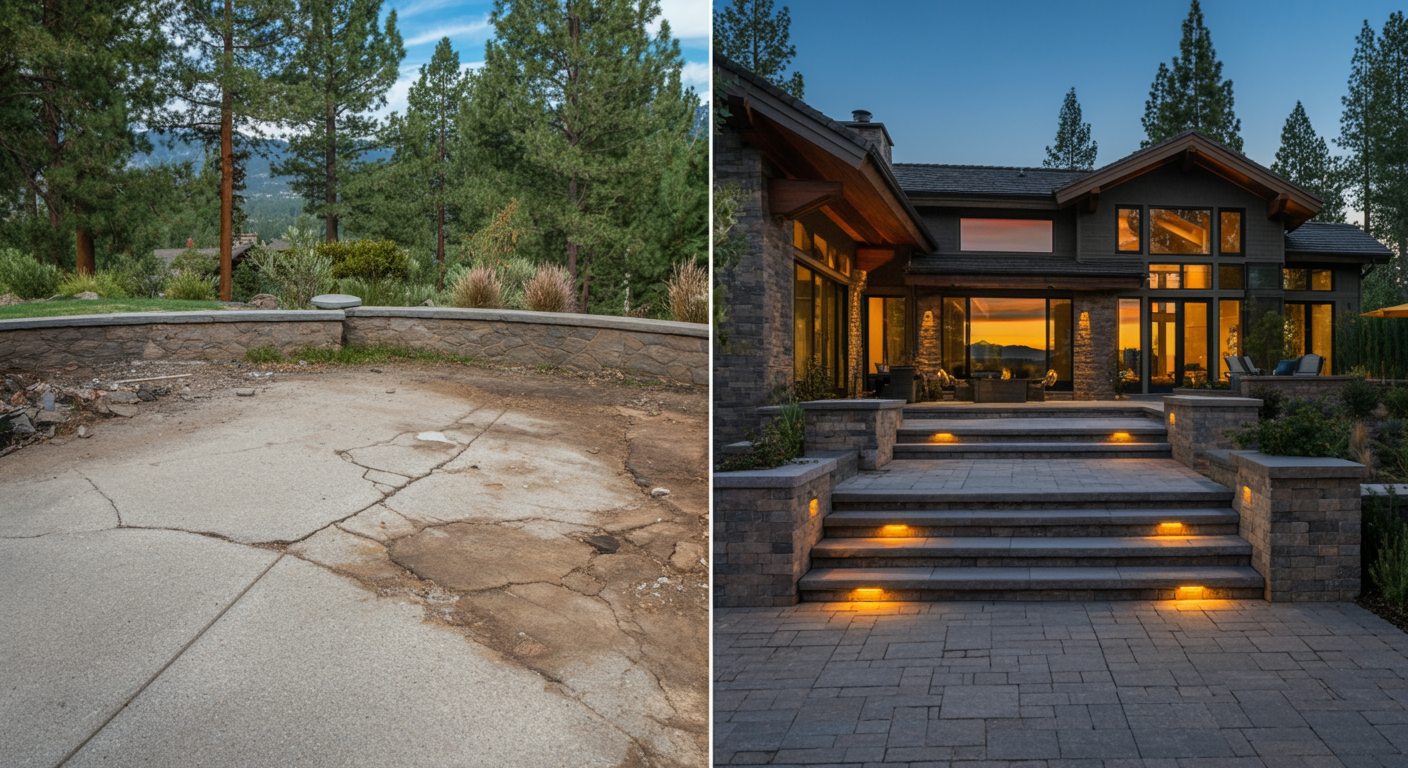
Many Incline Village homeowners inherit patio installations from previous owners—or face deterioration in their own aging hardscape after years of Lake Tahoe winters. Before scheduling a full demolition and replacement, a professional assessment often reveals that targeted renovation can restore performance and appearance at 30–50% of the cost of full replacement.
Lakescaping LLC performs patio renovation assessments as a complimentary service for prospective clients. We evaluate the existing base, identify the root cause of any failures, and provide honest recommendations about whether renovation or replacement is the appropriate solution for your specific situation.
The most common patio failure at altitude is differential frost heave—pavers or slabs lifting unevenly due to freeze-thaw movement in saturated base material. This appears as a wavy, uneven surface with some units standing significantly higher than neighbors. Differential heave indicates a drainage problem beneath the surface: water is reaching and saturating the base aggregate, then expanding during freezing.
Renovation approach: Lift the affected pavers, excavate to diagnose and correct the drainage problem (often a perimeter drain or sub-slab drain is needed), add and compact base material to restore level, and relay the pavers. This targeted repair can be much less expensive than full demolition if the problem is confined to a portion of the patio.
Pavers migrating laterally at the edge of a patio, with a gap opening between the edge restraint and the paver field, indicate edge restraint failure. Metal or plastic edge restraints that were not properly pinned, or that have corroded, allow the paver field to spread outward under thermal expansion and foot traffic loads.
Renovation approach: Remove and replace the perimeter edge restraints with commercial-grade plastic or aluminum restraint with 12-inch spike spacing. Re-set any displaced pavers and re-sand joints in the affected area.
Polymeric sand joints that have eroded to bare aggregate allow weed germination between pavers and reduce the lateral interlock that keeps the paver field stable. In severe cases, ants and other insects colonize eroded joints and accelerate the problem.
Renovation approach: Power wash the surface to remove existing joint material, blow joints clear of debris, and apply fresh polymeric sand. Sealing the paver surface after re-sanding extends the joint life significantly.
Concrete pavers and natural stone develop surface staining from pine sap, tannin from oak leaves, rust from metal furniture, and white mineral deposits (efflorescence) from water migrating through the paver body. These surface issues do not affect structural performance but significantly impact appearance.
Renovation approach: Specialized cleaning products are available for each stain type. We use pH-neutral cleaners for general cleaning, efflorescence removers for mineral deposits, and organic stain removers for biological staining. Surface sealing after cleaning protects against future staining.
A comprehensive patio renovation by Lakescaping LLC typically follows this sequence:
Not all patio problems are worth renovating. We recommend full replacement when:
Lakescaping LLC (Nevada C-10 #0086320) has served property owners in Incline Village, Crystal Bay, Glenbrook, and Zephyr Cove for 33+ years. Contact us for a no-obligation on-site consultation.
Serving Nevada properties only — Incline Village, Crystal Bay, Glenbrook, and Zephyr Cove.
A professional assessment is the most reliable way to make this determination. Key indicators that favor renovation: the base system is sound (firm when probed), the paver units themselves are in good condition, and problems are confined to less than 40% of the surface. Indicators that favor replacement: base material is intermixed with subgrade, paver units are spalling or cracking, or the base depth is insufficient for Lake Tahoe elevations.
Targeted patio renovation (lift-and-relay in problem areas, joint restoration, surface cleaning) typically costs $8–$15/sf for the work area. Full patio replacement with properly engineered base costs $18–$28/sf. For patios where targeted renovation can address 100% of the problems, the cost savings are significant. For patios with systemic base failures, full replacement is often more economical over a 10-year horizon.
Exact matching depends on whether the original product is still being manufactured and whether the existing pavers have weathered significantly. Belgard products typically remain in production for 10+ years with consistent color batches. Natural stone replacement matching is more challenging—we recommend selecting accent stone that complements rather than exactly matches the existing installation.
A standard patio renovation (500–1,000 sf) involving lift-and-relay in problem areas, drainage correction, joint restoration, and surface sealing typically takes 2–3 days. Larger areas or more extensive drainage corrections extend the timeline. All renovation work is scheduled within the May–October installation window.
Renovation work that does not increase the total impervious surface coverage of the property typically does not require a TRPA permit. Maintenance repairs to existing hardscape are generally exempt from permit requirements. We verify TRPA status during our initial assessment for every renovation project.
our mountain estate deserves expert craftsmanship. Partner with our licensed Nevada team to design and build a resilient, high-end landscape tailored to your vision.