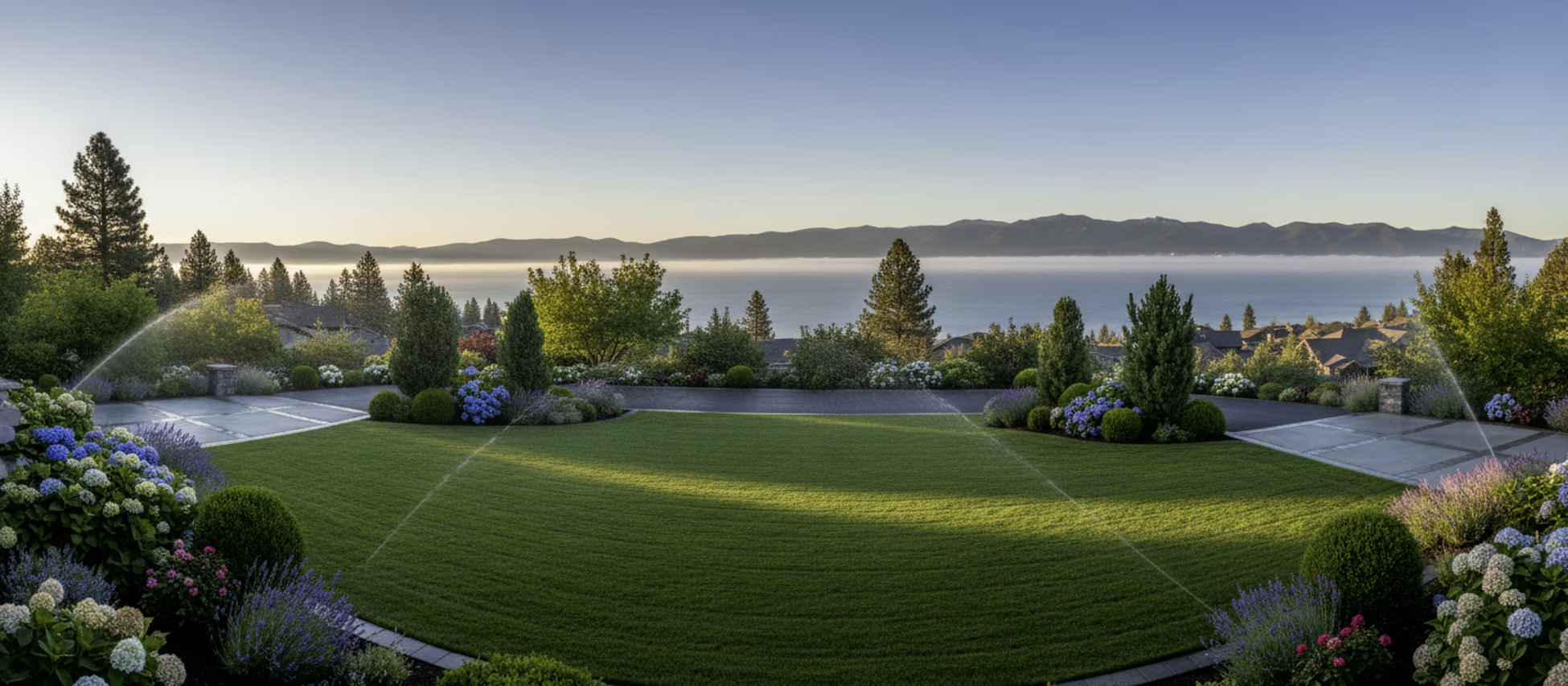

Native plant landscaping at Lake Tahoe elevations is not a compromise—it is the highest-performance approach available. Native species adapted to the Tahoe Basin require no irrigation once established, require minimal maintenance, support local wildlife, and satisfy TRPA's BMP landscape standards. Lakescaping LLC designs and installs native plant landscapes that achieve low maintenance and regulatory compliance while creating the naturalistic alpine character that defines the best Tahoe Basin properties.
Native plants of the Great Basin and Sierra Nevada have co-evolved with the specific soil chemistry, precipitation regime, temperature range, and wildlife of the Lake Tahoe region over thousands of years. They are, by definition, already perfectly adapted to the conditions that make planting at 6,200 feet challenging for non-native species: late snowmelt, compressed growing seasons, granitic soils with limited water-holding capacity, and freeze-thaw cycling that damages shallow root systems.
TRPA's Best Management Practice standards for residential landscaping in the Lake Tahoe Basin specifically encourage the use of native and drought-adapted plant species to reduce irrigation demand and nutrient runoff. Replacing non-native, irrigated plantings with established native plantings is one of the most effective steps an Incline Village property owner can take to improve BMP compliance while reducing ongoing maintenance costs.
Ponderosa Pine (Pinus ponderosa): The iconic tree of the Lake Tahoe landscape. Its distinctive vanilla-scented bark, open canopy, and tolerance of rocky, well-drained soils make it an excellent specimen tree for larger properties. Slow to establish but essentially self-sufficient once rooted. Requires defensible space pruning near structures per Nevada Division of Forestry guidelines.
Jeffrey Pine (Pinus jeffreyi): Similar in appearance to ponderosa pine but found at higher elevations in the Tahoe Basin. Strongly butterscotch-scented bark. More cold-tolerant than ponderosa. The dominant pine species on many Incline Village lots.
Mountain Mahogany (Cercocarpus ledifolius): A large native shrub to small tree with feathery seed plumes, extremely drought-tolerant and fire-resistant. Excellent for slopes and rocky areas where other species struggle. Long-lived and low-maintenance once established.
Greenleaf Manzanita (Arctostaphylos patula): One of the most valuable native shrubs for Tahoe landscapes. Smooth cinnamon-red bark, evergreen foliage, white spring flowers attractive to pollinators, and red berries that provide wildlife forage. Extremely fire-resistant relative to many non-native ornamentals. Tolerates poor, rocky soil and full sun. Requires no irrigation once established.
Antelope Bitterbrush (Purshia tridentata): A medium-sized deciduous shrub with small yellow flowers in early summer, important wildlife forage plant (deer, birds, small mammals), and exceptional drought tolerance. Excellent for naturalistic plantings on slopes and disturbed areas.
Sierra Currant (Ribes nevadense): A native currant with attractive pink flower clusters in spring and dark berries in summer. More shade-tolerant than most Tahoe natives—useful under pines where other shrubs struggle. Spreads slowly by seed and can be used for naturalistic understory plantings.
Snowbrush Ceanothus (Ceanothus velutinus): A large, fragrant native shrub with glossy, resinous foliage and white flower clusters. Nitrogen-fixing roots improve soil fertility. Tends to colonize after disturbance and provides excellent erosion control on slopes.
Native Lupine (Lupinus species): Several lupine species are native to the Tahoe Basin and thrive at Incline Village elevations. Showy blue-purple flower spikes in early summer, nitrogen-fixing root nodules, and excellent drought tolerance. Self-seeds readily in disturbed soil.
Sulfur Buckwheat (Eriogonum umbellatum): A low-growing perennial with yellow flower clusters that age to rust-red, providing season-long visual interest. Extremely drought-tolerant on rocky, well-drained soils. Native to the Great Basin and Sierra Nevada.
Penstemon (Penstemon species): Multiple penstemon species native to the Tahoe region provide showy tubular flowers in pink, red, or purple, attracting hummingbirds. Low-water once established. Excellent for rocky slopes and dry planting areas.
Native plants require supplemental irrigation during their establishment period—typically 2–3 seasons—to develop root systems adequate to survive on natural precipitation alone. The establishment phase is critical: native plants that are overwatered during establishment develop shallow root systems that do not withstand drought once irrigation is removed. We follow these establishment protocols:
Installation timing: Fall planting (September–October) is preferred for most Tahoe Basin natives. Fall-planted shrubs establish roots before soil temperatures drop, entering their first summer with better root development than spring-planted stock.
Soil preparation: We avoid heavy amendment of the native granitic soil in planting beds for native species. Over-amended soil creates a “bathtub” effect where plant roots remain in the amended zone rather than extending into the surrounding native soil. Light incorporation of organic matter (no more than 10% by volume) is appropriate for severely compacted or disturbed soils.
Irrigation scheduling: Drip irrigation (Rainbird or Toro emitter systems) delivers water directly to the root zone during the establishment period. We program smart controllers to taper irrigation frequency across the establishment period—heavy irrigation the first summer, reduced the second, minimal the third before removal.
Lakescaping LLC (Nevada C-10 #0086320) has served property owners in Incline Village, Crystal Bay, Glenbrook, and Zephyr Cove for 33+ years. Contact us for a no-obligation on-site consultation to assess your property's specific needs.
Serving Nevada properties only — Incline Village, Crystal Bay, Glenbrook, and Zephyr Cove.
Antelope bitterbrush, greenleaf manzanita, snowbrush ceanothus, and native bunch grasses (Idaho fescue, blue wildrye) are excellent choices for slopes at Incline Village elevations. These species develop deep root systems that stabilize slopes while requiring no irrigation after establishment. Sulfur buckwheat works well as a low-growing groundcover in rocky slope situations. We can design a slope planting plan that provides erosion control, wildlife habitat, and low-maintenance beauty.
Most Tahoe Basin natives require zero supplemental irrigation after a 2–3 year establishment period. Exceptions include container-grown specimens in exposed locations or those planted in areas with faster soil drainage than typical Tahoe soils. During the establishment period, we use drip irrigation (Rainbird or Toro) to supplement natural precipitation, programmed to taper water delivery as the plants develop sufficient root systems to access natural soil moisture.
Relative fire resistance varies by species, but many Tahoe Basin natives are significantly more fire-resistant than non-native ornamental plants. Greenleaf manzanita, mountain mahogany, and bitterbrush have lower fuel moisture content and less fine fuel accumulation than plants like ornamental grasses and many non-native shrubs. A landscape predominantly composed of native species, with defensible space pruning of pines and removal of dead wood, presents significantly lower fire risk than a non-native, high-irrigation landscape.
TRPA's BMP compliance framework includes landscape management as a factor in overall site compliance. Replacing irrigated non-native turf and plantings with native species reduces runoff and nutrient loading, which are the primary metrics TRPA tracks. While there is no formal 'credit' system for native plantings, BMP compliance with a native landscape is significantly easier to demonstrate than with an irrigated non-native landscape. We can assess your property's BMP status and recommend native planting improvements that address compliance gaps.
Fall planting (September through October) is generally preferred for native shrubs and perennials in the Tahoe Basin. Fall-planted stock has the opportunity to establish root growth before soil freezes, giving plants a head start on their first growing season. Spring planting (May–June after frost) is also acceptable, though spring-planted stock typically shows slightly slower first-year establishment. Container-grown plants can be installed at any time during the frost-free season if irrigation is available during establishment.
our mountain estate deserves expert craftsmanship. Partner with our licensed Nevada team to design and build a resilient, high-end landscape tailored to your vision.