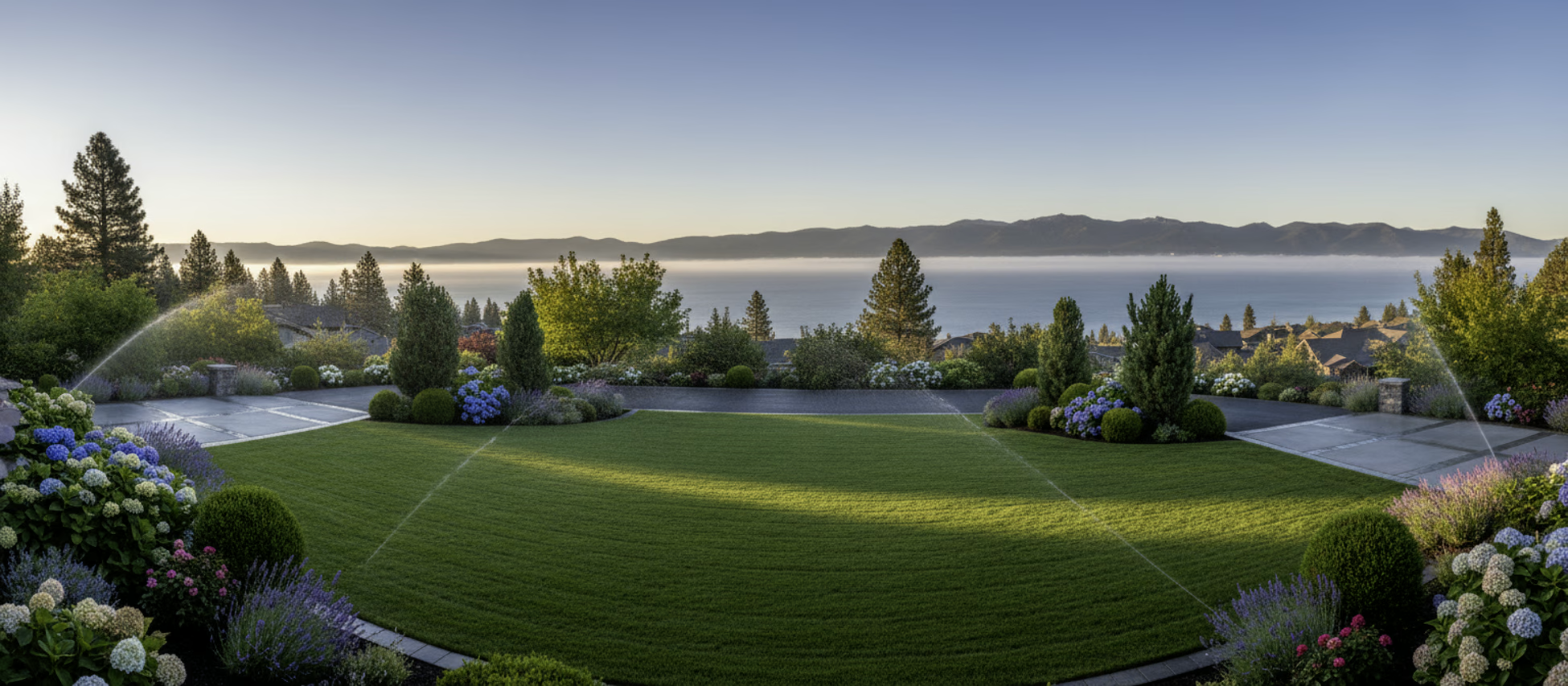

At Incline Village and Crystal Bay elevations, every landscape project is an engineering project. Freeze-thaw cycling, heavy snowpack, granitic soils, and drainage from 200+ inches of annual snowfall stress landscape systems in ways that temperate-climate design standards do not account for. Lakescaping LLC's engineering-first approach starts every project with structural and drainage design—before aesthetics, before materials, before plant selection. The aesthetic decisions are made within the constraints that engineering establishes.
A landscape that looks beautiful on installation day is not a successful project. A successful landscape at Incline Village still looks as good—and functions as well—after 20 Lake Tahoe winters as it did on completion day. The difference between a landscape that achieves this and one that degrades into an expensive maintenance problem within 5 years is almost entirely in the engineering decisions made before the first shovel entered the ground.
Lakescaping LLC's engineering-first philosophy means that we resolve the structural, drainage, and material science questions before we discuss aesthetics. The aesthetic choices—stone type, plant selection, lighting style—are made within the constraints established by engineering. This approach may seem limiting in design discussions, but it produces results that hold up where superficially attractive designs fail.
The granitic soils of the Lake Tahoe Basin present specific challenges for landscape construction that differ from the clay or alluvial soils more common in lower-elevation landscapes:
Low cohesion: Granitic soils have low cohesion between particles—they hold together when moist but can collapse readily when dry or disturbed. Excavation stability and compaction requirements are different from clay soils. Over-excavation creates collapsed trench walls; under-compaction of base material leaves voids that settle under loading.
Variable infiltration: Granitic soil infiltration rates vary dramatically with decomposition state. Fresh granite bedrock is nearly impervious; decomposed granite (DG) infiltrates rapidly. Drainage system design must account for the actual infiltration rate of the specific soil at each project location, not a textbook assumption.
Limited water-holding capacity: The low organic matter content and rapid drainage of granitic soils means that plants experience more moisture stress than the precipitation record would suggest. Irrigation system design and plant selection must account for the actual water-holding capacity of the soil, not just total rainfall.
Freeze-thaw cycling is the primary cause of hardscape failure in the Tahoe Basin. Ice occupies approximately 9% more volume than liquid water—when water-saturated base material freezes, it expands, lifting the overlying hardscape. When the ice thaws, the hardscape settles, but not always to its original position. Repeated over dozens of cycles per winter season, and hundreds of cycles over a lifetime, inadequate base design results in heaved, settled, and displaced hardscape surfaces.
Our freeze-thaw engineering standards:
Drainage before everything else: Water that cannot reach the base material cannot freeze there. Positive drainage away from all hardscape, perimeter drainage systems around paved areas, and open-graded (no-fines) base material that does not retain water are the foundation of freeze-thaw resistant hardscape.
Base depth below frost line: The frost line at Incline Village reaches approximately 24 inches in most soils. Hardscape base systems that extend to this depth are not affected by the freeze-thaw zone above—they remain stable while shallower systems heave. Our minimum base specification: 8 inches for pedestrian paving, 10 inches for vehicle paving.
Flexible joint systems: Rigid joint systems (mortared joints) crack when the paving moves. Polymeric sand joint systems for concrete pavers, and gravel or sand joints for natural stone, accommodate small thermal movements without failure. We specify polymeric sand from Belgard's own joint stabilizer product line for all concrete paver installations.
Every Lakescaping LLC project includes a drainage assessment as a required scope item. We evaluate existing site drainage before proposing any construction, identify areas where drainage improvements are needed, and design drainage systems as integral elements of the landscape rather than afterthoughts. Common drainage components in our projects:
Surface drainage: Minimum 2% slope away from structures and across all paved surfaces. Channel drains at low points in paved areas. Concrete or stone splash blocks under downspout outlets to prevent erosion.
Subsurface drainage: French drains at the base of retaining walls. Perforated pipe collection systems at the upslope edge of paved areas. Drainage outlets positioned to discharge to pervious areas or storm drain systems without creating erosion.
Snowmelt management: Drainage systems must handle not just rainfall but concentrated snowmelt, which at Lake Tahoe represents the equivalent of 200+ inches of precipitation in a compressed timeframe. We size drainage systems for the snowmelt event, not just the design storm.
Lakescaping LLC (Nevada C-10 #0086320) has served property owners in Incline Village, Crystal Bay, Glenbrook, and Zephyr Cove for 33+ years. Contact us for a no-obligation on-site consultation to assess your property's specific needs.
Serving Nevada properties only — Incline Village, Crystal Bay, Glenbrook, and Zephyr Cove.
Our minimum base depth specifications: 8 inches of compacted Class II aggregate base for pedestrian paving (walkways, patios), 10 inches for vehicle-rated paving (driveways, parking areas). These exceed standard minimums for temperate climates because the aggressive freeze-thaw cycling at 6,200 feet elevation requires additional base depth to prevent heave. The base is compacted in 3–4 inch lifts to achieve 95% proctor density — proper compaction is as important as depth.
Steep slopes at Incline Village require drainage systems that intercept upslope water before it reaches the construction area, convey water across or around the slope without erosive velocity, and discharge at locations where the energy can be dissipated without causing downstream erosion. Typical elements include upslope French drains to intercept groundwater, armored channel drains in areas of concentrated flow, and level spreaders or infiltration areas at discharge points. We assess the full drainage watershed, not just the immediate project area.
We specify polymeric sand for all concrete paver joints at Incline Village. Polymeric sand contains a polymer binder that hardens when wetted and cured, creating a semi-flexible joint that resists washout, inhibits weed germination, and discourages insect nesting in the joints. For Belgard paver installations, we use Belgard's own joint stabilizer product, which is formulated to be compatible with Belgard's paver surface chemistry. Polymeric sand joints should be refreshed every 5–7 years as the binder degrades.
Yes. Compacted soil at Incline Village reduces root penetration depth, decreasing drought tolerance and stability. It also impedes drainage, creating the waterlogged conditions that damage roots and promote root pathogens. Construction compaction is the most common cause of poor tree establishment at properties that have been recently built or remodeled. We use air-spade equipment to relieve severe compaction without damaging roots, and we protect root zones during construction with temporary fencing to exclude equipment.
Inadequate drainage is the most common construction defect we encounter when assessing existing landscapes at Incline Village and Crystal Bay. This manifests as heaved hardscape, retaining wall failures, plant loss from waterlogged root zones, and erosion in areas that should have stable groundcover. The underlying cause is almost always the same: drainage was not designed as an engineering system — it was assumed that water would 'drain somewhere' without explicit routing design. Water follows the path of least resistance, which is not always the intended path.
our mountain estate deserves expert craftsmanship. Partner with our licensed Nevada team to design and build a resilient, high-end landscape tailored to your vision.