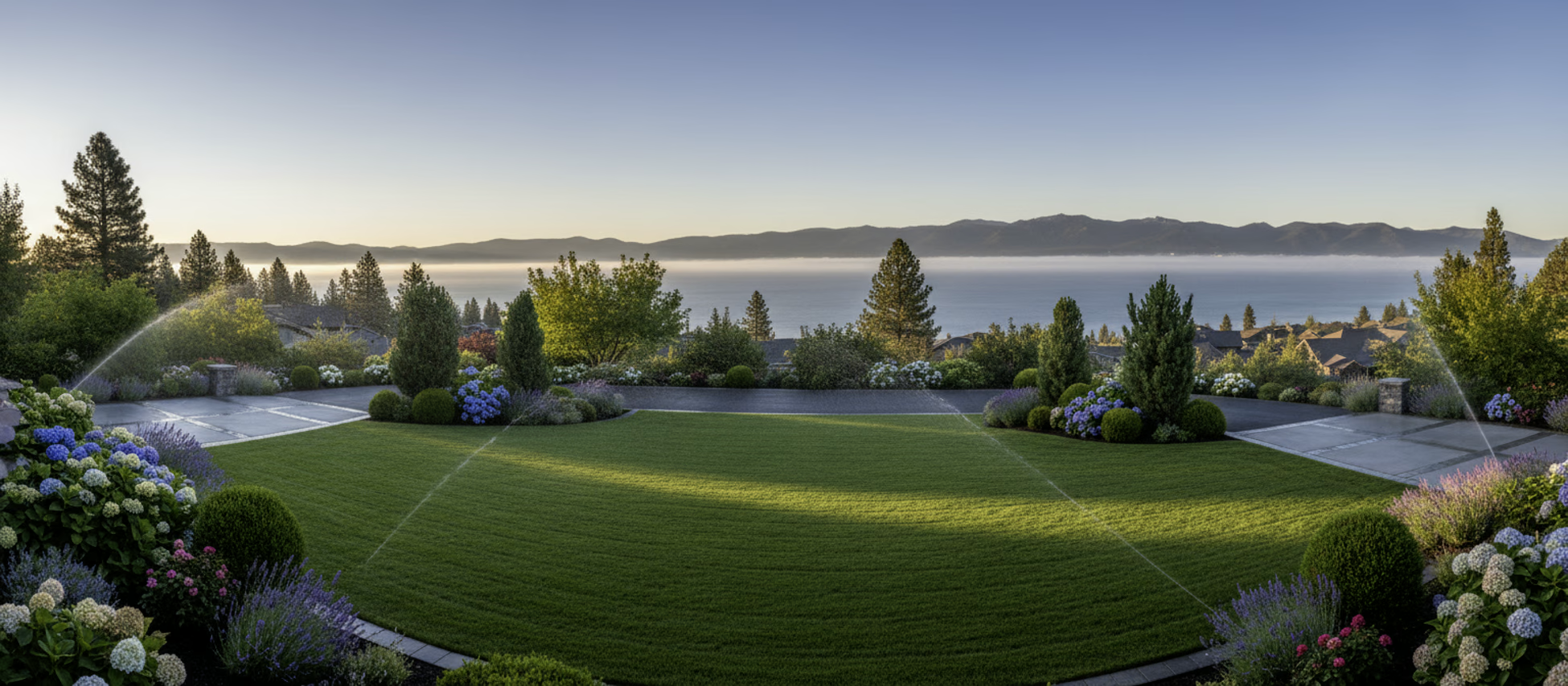

Irrigation System Remodeling in Incline Village, Nevada – more than just fixing leaks, it's about adapting to the unique challenges of high elevation and embracing modern water conservation technology. At Lake Scaping LLC, we specialize in transforming outdated irrigation systems into efficient, smart, and sustainable water delivery networks for properties in Incline Village, Crystal Bay, and surrounding Nevada Lake Tahoe communities.
The unique climate of Incline Village at 6,200 feet elevation creates distinct irrigation challenges. The short growing season from late May to mid-September, combined with extreme temperature variations and unpredictable precipitation patterns, demands a sophisticated approach to irrigation management. Traditional irrigation systems simply don't account for these high-altitude variables, leading to water waste and plant stress.
Our irrigation remodeling services address these specific challenges by:
Irrigation systems at Incline Village properties are working under conditions that accelerate component wear and create inefficiency: the 6,200-foot UV intensity degrades exposed plastic components faster than at lower elevation; the short freeze-thaw season requires precise winterization timing that many system owners miss; and the compressed growing season (90–120 days) means that each irrigation event represents a larger fraction of the total seasonal water budget than in longer-season climates.
An irrigation system remodel at Incline Village typically achieves 30–50% water use reduction while improving plant health. The combination of smart ET-based controller technology, drip conversion in planting areas, properly rated spray heads, and corrected zone coverage generates immediate water savings that provide a measurable ROI against the remodel cost. Water savings at IVGID water rates, combined with reduced plant replacement cost from improved coverage, typically produce a payback period of 3–6 years for comprehensive remodels.
Every Lakescaping irrigation remodel begins with a comprehensive system assessment that documents current performance and identifies upgrade opportunities:
Controller evaluation: Current controller type (conventional timer vs. smart ET-based), programming complexity, and condition. Conventional timers without ET-based adjustment run the same schedule regardless of rainfall or temperature, systematically over-watering during cool or wet periods and under-watering during heat events.
Zone-by-zone flow testing: We measure actual flow on each zone and compare to expected flow for the head types and counts on that zone. Flow higher than expected indicates a broken head or pipe leak; flow lower than expected indicates a clogged filter, failing valve, or supply pressure problem.
Head coverage mapping: We run each zone and map actual spray coverage, identifying head-to-head coverage gaps (dry spots), misting conditions (indication of over-pressure), and coverage overlap with adjacent zones.
Backflow preventer testing: We test the backflow preventer annually as part of our maintenance programs and as a standard element of irrigation assessment. Failed backflow preventers are a code violation and a contamination risk.
Pipe and valve condition: We check valve operation and inspect accessible pipe for UV degradation, root intrusion, and repair history. Older systems with significant repair history in pipe and fittings often benefit from zone pipe replacement as part of a broader remodel.
Replacing a conventional timer controller with a Rainbird or Toro smart ET-based controller is the single highest-ROI irrigation upgrade available for most Incline Village properties. Smart controllers use local weather data (temperature, solar radiation, wind, humidity) to calculate actual evapotranspiration (ET) and adjust the irrigation schedule to replace only the water lost to ET and transpiration — not a fixed programmed volume regardless of conditions.
At Incline Village, where weather variability is high — cool rainy periods followed by hot, dry, windy conditions — the difference between actual ET demand and a fixed timer schedule is substantial. Smart controllers consistently reduce water use 20–30% compared to conventional timers programmed by the property owner.
Both Rainbird and Toro smart controllers we install offer Wi-Fi connectivity and smartphone app access, allowing remote monitoring and schedule adjustment. Seasonal program adjustment — spring startup, summer peak, fall preparation, winterization — is built into the controller and managed automatically or with minimal input from the property owner.
Spray heads operating over planting areas — trees, shrubs, perennial beds, groundcovers — are typically 50–70% less efficient than drip irrigation delivering the same water volume. Spray systems apply water over the full surface area of the bed, including mulch and bare soil, where it is lost to evaporation. Drip systems apply water at the root zone of individual plants, where it is available for plant uptake with minimal evaporation loss.
Drip conversion in planting areas involves installing drip mainline, pressure-compensating emitters at each plant, and filter/pressure regulator assemblies at each zone valve. We size emitter flow rates to the water requirement of the specific plant type and adjust as plants establish and mature.
At Incline Village, drip systems for woody plants are typically run on a deep, infrequent schedule (1–2 times per week for established plants) rather than the frequent, short runs appropriate for turf. Deep watering promotes deep root development that increases drought tolerance and winter hardiness — a critical factor for plants at the margin of their cold hardiness range at 6,200 feet.
Irrigation winterization — the compressed-air blow-out of all zones before the first hard freeze — is the most consequential single annual irrigation service at Incline Village. A missed or poorly executed winterization means cracked pipes, failed heads, and split valves that require extensive repair in spring. The window for winterization at Incline Village is narrow: typically mid-September through early October, before the first hard freeze but after the last heat event that warrants continued irrigation.
Lakescaping performs irrigation winterization with professional-grade rotary-screw compressors that deliver the CFM needed to fully clear all zones in a single pass — 20+ CFM at 50 PSI, sustained over the full zone blow-out sequence. Consumer-grade electric compressors commonly used for DIY winterization typically do not have sufficient CFM to fully clear zones on larger systems, leaving water in the lower portions of spray heads and drip emitters that freezes and causes damage.
Lakescaping LLC (Nevada C-10 #0086320) has served property owners in Incline Village, Crystal Bay, Glenbrook, and Zephyr Cove for 33+ years. Contact us for a no-obligation on-site consultation to assess your property's specific needs.
Serving Nevada properties only — Incline Village, Crystal Bay, Glenbrook, and Zephyr Cove.
Rainbird and Toro smart ET-based controllers are our primary recommendations for Incline Village properties. Both brands offer residential and commercial-grade smart controllers with Wi-Fi connectivity, ET-based scheduling, and comprehensive zone programming capabilities. The specific model recommendation depends on zone count, power supply configuration, and remote access requirements. We size and specify controllers based on the full system requirements rather than recommending a single product regardless of application.
Targeted repairs are appropriate when the system has isolated failures — a broken head, a failed valve, a cracked pipe section — on an otherwise functional, efficiently designed system. A full remodel is warranted when the system has: a conventional timer controller (highest-ROI upgrade), spray coverage of planting areas that should be on drip, consistent coverage gaps or dry spots that reflect design deficiencies, aging pipe or fittings with multiple failure history, or overall water use that is disproportionate to the planted area. Our assessment process distinguishes between repair candidates and remodel candidates before we recommend scope.
Based on our remodel projects at Incline Village, typical water use reductions are: smart controller upgrade alone — 20–30% reduction; smart controller plus drip conversion in planting areas — 35–50% reduction; comprehensive remodel with all three (controller, drip conversion, coverage correction) — 40–60% reduction. The percentage depends on the baseline efficiency of the existing system — older systems with conventional timers and spray heads over planting areas have the largest improvement potential.
Irrigation startup at Incline Village should be delayed until soil temperatures at 6 inches depth consistently exceed 45°F and the risk of hard freezes (below 28°F) has passed — typically late May to early June. Starting the system earlier wastes water on plants that are still dormant and risks damage from a late-season hard freeze. Rainbird and Toro smart controllers can be programmed with a seasonal start date that prevents watering before the specified date regardless of thermostat settings.
DIY winterization is possible if you have a rotary-screw compressor with sufficient CFM output (minimum 20 CFM at 50 PSI) for the full system. Consumer-grade electric compressors typically deliver 5–10 CFM at rated pressure — insufficient for reliable zone clearing on larger systems. Incomplete blow-out leaves water in low points of spray heads and drip emitters that freezes and causes damage. Given the repair costs of a failed winterization (typically $800–$2,500 or more), professional winterization is cost-effective for most property owners.
our mountain estate deserves expert craftsmanship. Partner with our licensed Nevada team to design and build a resilient, high-end landscape tailored to your vision.