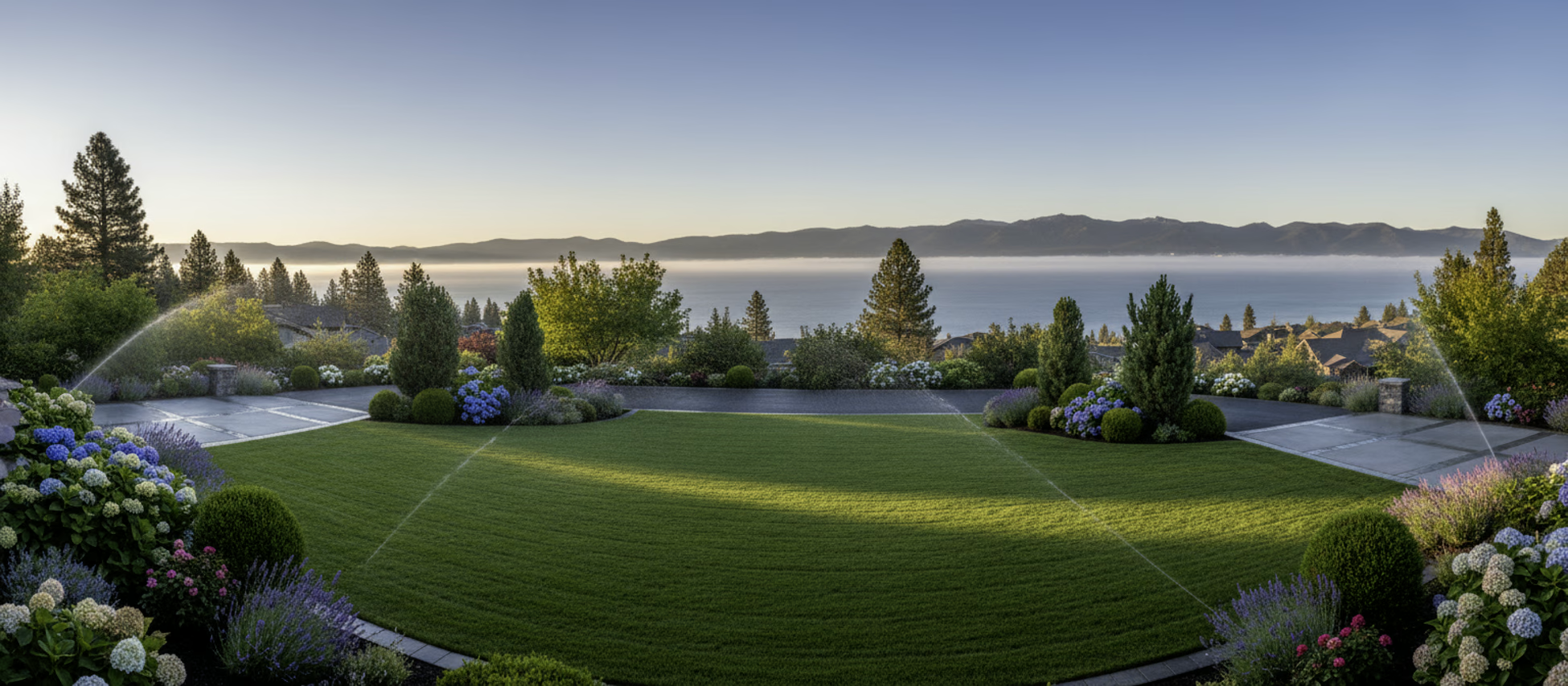

Welcome to Lake Scaping's comprehensive guide to fire-safe landscape remodeling in Incline Village and Crystal Bay, Nevada. As a premier landscape design company operating in the Wildland Urban Interface (WUI), we understand the unique challenges and opportunities presented by the high-elevation Sierra Nevada environment at 6,200 feet above sea level. Our approach combines expert knowledge of fire ecology with sophisticated design principles to create landscapes that are both beautiful and defensible against wildfire.
Properties in Incline Village and surrounding areas exist in a high-risk Wildland Urban Interface zone characterized by:
Recent decades have witnessed a significant increase in both the frequency and intensity of wildfires affecting properties in the Incline Village WUI. Our fire-safe remodeling services address these specific challenges through:
Lake Scaping's fire-safe landscape remodeling process begins with a thorough assessment of your property's specific fire risk factors. Our certified professionals analyze topography, drainage patterns, existing vegetation types and densities, structure-to-vegetation distances, and local fire history.
Creating an effective defensible space around your property is the cornerstone of fire-safe landscape remodeling. Our approach includes strategic fuel reduction zones, plant health and moisture management, non-combustible hardscaping elements, and water access and distribution systems.
Native Nevada plants adapted to the high-elevation environment include many species with natural fire resistance. Our plant palette includes Sierra Nevada natives like Jeffrey pine, bitterbrush, and serviceberry, carefully selected to maintain ecological integrity while reducing fire risk.
Our fire-safe landscape remodeling services ensure full WUI compliance with Nevada state regulations, including creating and maintaining 100-foot defensible space, implementing 30/50/100 firebreak protocols, and coordinating with local fire agencies.
Crystal Bay's location on the Nevada-California state line at the northern end of Lake Tahoe places it in one of the most fire-complex environments in the Sierra Nevada. The convergence of dry east winds (Washoe Zephyr and offshore flow conditions), abundant native fuel (ponderosa and Jeffrey pine, white fir, manzanita understory), and the topographic funneling of fire from the Carson Range create conditions where fires can move rapidly and with extreme intensity.
The Caldor Fire (2021) and Tamarack Fire (2021), while south of the Tahoe Basin, demonstrated that high-intensity fires can move through terrain similar to Crystal Bay's with speeds and spotting distances that make structural protection impossible without prior defensible space preparation. Property owners who had completed defensible space work before the fires had measurably better outcomes.
Crystal Bay lakefront properties face a specific defensible space geometry challenge: the lake-facing side of the property typically has vegetation that provides privacy, views framing, and aesthetic character—vegetation that may also constitute significant ladder fuel potential if allowed to grow in an unmanaged state. The solution is selective management rather than clearance: maintaining individual specimens with appropriate spacing and limb clearance while preserving the visual screen and character they provide.
Several Crystal Bay properties are built on steep slopes above the lake or above Highway 28. Fire behavior on slopes is significantly more aggressive than on flat terrain—fire burns upslope faster than across flat ground, and the convective preheating of upslope vegetation accelerates fire spread. Steeper properties require Zone 1 clearance that extends further laterally than the 30-foot minimum standard to account for the increased fire behavior on slopes.
Crystal Bay properties within HOA boundaries require ARC approval for significant tree removal or vegetation clearing. TRPA requires documentation of the fire safety basis for tree removal within the Tahoe Basin. We prepare defensible space plans that are simultaneously compliant with Nevada Division of Forestry standards, TRPA vegetation management guidance, and applicable HOA requirements.
A defensible space is most effective when the maintained areas are occupied by fire-resistant materials and plant species, not bare ground. Our upgrade approach for Crystal Bay properties:
Non-combustible hardscape in Zone 1: Decomposed granite, Basalite or Belgard concrete pavers, and natural granite in the immediate structure zone (0–10 feet from structure) provide a non-combustible interface that significantly reduces ember ignition potential at the structure perimeter.
Fire-resistant native plantings: Native shrubs with demonstrated fire resistance—greenleaf manzanita, mountain mahogany, antelope bitterbrush—can be incorporated in Zone 1 at appropriate spacing. These plants are aesthetically appropriate for Crystal Bay's naturalistic landscape character and, when properly spaced with non-combustible material between them, do not create a continuous fuel bed.
Irrigation for defensible space maintenance: A small drip irrigation system serving Zone 1 plantings keeps these plants at higher fuel moisture content during fire season. Even modest irrigation—supplementing natural precipitation with 0.5–1.0 inches per week during July–September—measurably improves the fire resistance of Zone 1 plantings.
Ember-resistant features: Modern fire science recognizes that structure ignition in wildland-urban interface fires most commonly results from ember accumulation, not direct flame contact. Features that reduce ember accumulation potential—covered eave vents, enclosed soffits, mesh screening on deck gaps, gutters cleared of pine needles—complement defensible space vegetation work.
Lakescaping LLC (Nevada C-10 #0086320) has served property owners in Incline Village, Crystal Bay, Glenbrook, and Zephyr Cove for 33+ years. Contact us for a no-obligation on-site consultation to assess your property's specific needs.
Serving Nevada properties only — Incline Village, Crystal Bay, Glenbrook, and Zephyr Cove.
Nevada Revised Statute 477.030 and TRPA defensible space guidance require Zone 1 clearance (0–30 feet from structure) and Zone 2 management (30–100 feet). On slopes greater than 20%, effective Zone 1 may need to extend further to compensate for increased fire spread rate upslope. Crystal Bay's proximity to the lake and HOA restrictions may further influence the specific clearance and replanting approach. We assess each property individually to determine the appropriate defensible space scope.
Yes. TRPA explicitly allows removal of trees required by Nevada defensible space regulations within the Lake Tahoe Basin, provided the removal is documented as meeting fire safety requirements. The documentation must establish that the specific tree being removed creates a fire safety hazard (ladder fuel, direct canopy connection to structure, dead/dying material) and that removal is required for compliance with Nevada law. We prepare this documentation as part of our defensible space plan.
Yes, in most cases. Defensible space does not require removal of all vegetation — it requires specific clearances (lower limb removal to 6–10 feet height, separation between canopy crowns) and reduction of continuous fuel beds. Most healthy, well-spaced trees can be retained with appropriate limb-raising. Dense, overcrowded tree clusters and continuous manzanita understory typically do require selective thinning, but the goal is to achieve separation, not elimination.
Fire-safe landscaping improvements maintain and enhance property value at Crystal Bay by reducing the risk of catastrophic loss, by demonstrating responsible stewardship to potential buyers who are increasingly aware of wildfire risk, and by satisfying HOA and potential insurance requirements that may affect coverage availability or cost. Properties with completed defensible space programs are increasingly differentiated in the Crystal Bay market.
April through June (post-snowmelt, pre-fire-season) is the optimal window for defensible space work at Crystal Bay. This timing allows completion before summer fire season while providing access after winter snowpack has cleared. It also respects the bark beetle avoidance window for pine pruning — completing limb removal before May keeps wounds closed before peak beetle flight season. We schedule defensible space projects for this window and prioritize completion before June 30.
our mountain estate deserves expert craftsmanship. Partner with our licensed Nevada team to design and build a resilient, high-end landscape tailored to your vision.